
Building trust when your team is spread out isn't about replicating the office online. It's about being deliberate. You have to shift from relying on spontaneous, in-person moments to creating structured, intentional opportunities for connection. This means setting up predictable communication patterns, celebrating real, demonstrated competence through recognition, and building a culture of empathy where people feel safe enough to be themselves. To succeed, you have to stop waiting for trust to happen and start actively designing an environment where it can grow.
Table of Contents
Why Remote Teams Face a Trust Crisis
The move to remote work gave us incredible flexibility, but it also silently chipped away at trust. In an office, trust is often a byproduct of just being around each other—the quick chat by the coffee machine, the nod of agreement in a meeting, the shared laugh over lunch. These small, consistent interactions build a foundation of rapport and psychological safety, often without us even realizing it.
Once you go virtual, those organic moments vanish. Suddenly, almost every interaction is scheduled and has an agenda. There's little room for the casual connections that form the bedrock of strong working relationships. Without that daily rhythm of physical presence, teams can feel disconnected, leading to misunderstandings and a slow erosion of the collaborative spirit. This is exactly why old-school trust-building methods don't work for distributed teams; you just can't replace hallway conversations with another scheduled Zoom call.
The Missing Pieces of Virtual Communication
The heart of the problem is the inherent limitation of digital communication. We lose so much context when we can't see body language or hear tone of voice. A delayed Slack message can be misinterpreted as a snub, or a short, direct email can come across as rude. In fact, research on global virtual teams confirms that the lack of non-verbal cues is a massive barrier to developing trust, which in turn hurts knowledge sharing and team performance. You can read the full research on communication challenges to see just how deep the impact goes.
This communication gap directly undermines the three pillars of virtual trust:
- Predictability: Can I count on my colleagues to do what they say they'll do?
- Competence: Do I believe in my team's skills and expertise to get the job done right?
- Empathy: Do I feel like my teammates understand and care about my perspective?
When these pillars start to crumble, performance is the first casualty. Innovation slows to a crawl, people become hesitant to ask for help, and keeping your best talent becomes a real struggle.
Why Recognition is a Critical Trust-Builder
In an office, it’s easy to see who’s putting in the extra hours or who just cracked a tough problem. But when everyone's remote, a huge amount of that hard work becomes invisible. This is where team recognition steps in as a surprisingly powerful tool for building trust. It's so much more than just saying "good job" because it makes invisible work visible and validates competence for the whole team to see.
Intentional recognition makes invisible work visible. When you publicly celebrate a specific contribution, you're not just rewarding an individual; you are reinforcing team values and showcasing what competence and reliability look like in your remote culture.
Think about it. A manager who sets up a dedicated Slack channel like #kudos where anyone can post shout-outs is doing more than just boosting morale. They are creating a living record of competence and effort.
When a developer gets a public shout-out for fixing a critical bug over the weekend, it builds trust not just with her manager, but with the entire team who now sees her commitment firsthand. That simple act turns an invisible effort into a concrete, visible data point of reliability, directly strengthening the pillars of trust for everyone to see.
Laying the Foundation for Virtual Trust
You can't just hope trust will magically appear in a remote team. It doesn't work that way. When you're not sharing an office, you have to be deliberate and intentional about building it. Waiting for it to happen organically is a recipe for disconnect and misunderstanding. The key is to bake trust-building activities into your team's DNA right from the start.
This all begins the moment a new person joins your team. Their first few weeks are absolutely critical—it's when they're forming their initial impressions of how things really work. A chaotic, impersonal onboarding experience sends a clear message: we're disorganized and don't have our act together. That's a tough first impression to overcome.
Architecting Trust from Day One
One of the most effective shortcuts I've seen for building rapport fast is having everyone create a personal "user manual." It sounds a bit technical, but it's really just a simple doc where each person outlines their work style, how they like to communicate, and what makes them tick. It's a cheat sheet for getting to know your colleagues on a deeper level, something that might otherwise take months of trial and error.
For example, a user manual could include tidbits like:
- My Core Hours: "I'm sharpest and most responsive between 7 AM and 3 PM EST."
- Best Way to Reach Me: "If it's a real emergency, text me. Otherwise, a Slack DM is perfect."
- How I Like Feedback: "I prefer direct, honest feedback in our one-on-ones. Don't worry about hurting my feelings."
- How I Recharge: "I usually step away for a quick walk around noon to clear my head."
This isn't about oversharing; it's about giving your teammates a roadmap for how to best work with you. It removes the guesswork and friction that so often create tension in remote settings. You're showing that you care enough to help others understand you.
This kind of intentional effort directly feeds into the core pillars of trust—predictability, competence, and empathy.
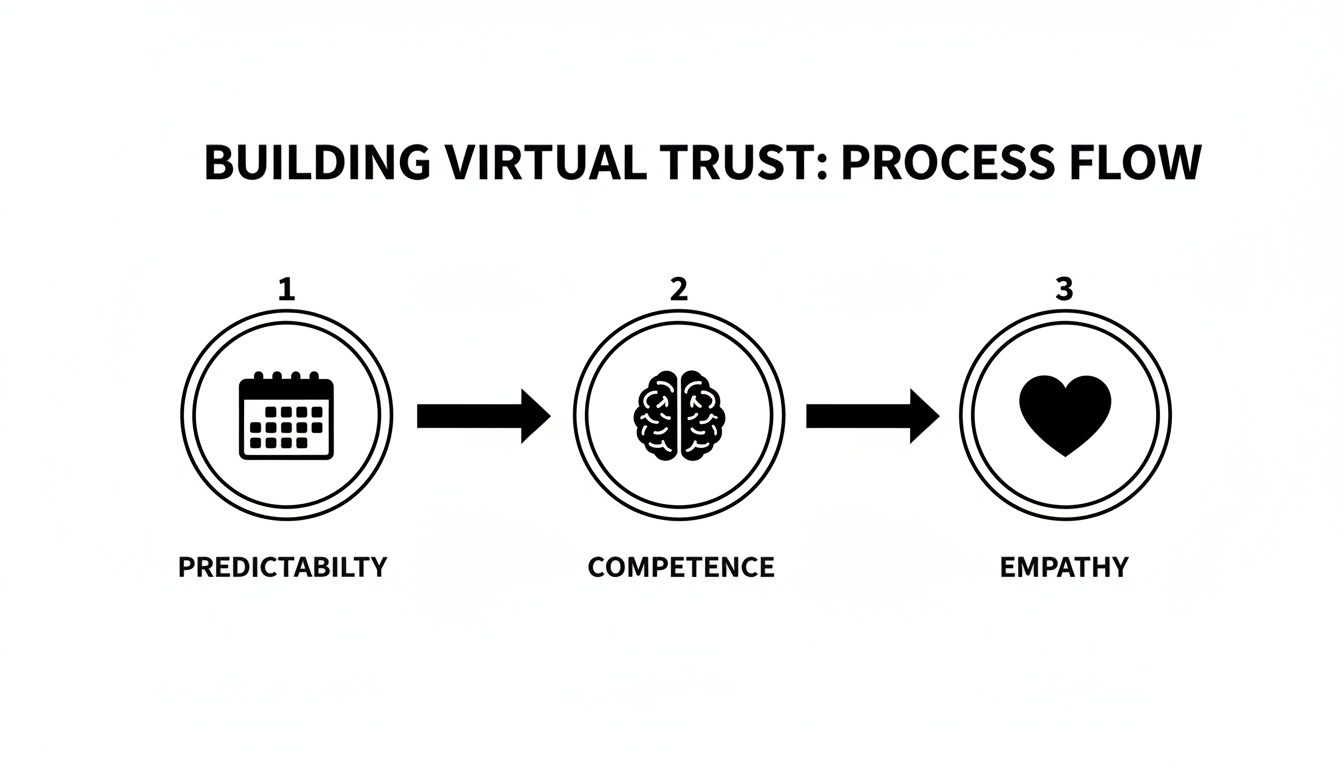
As you can see, it’s a cycle. When you act with empathy, demonstrate your skills, and behave consistently, you build a powerful foundation of trust that reinforces itself over time.
Establishing Clear Communication Norms
Beyond individual manuals, the entire team needs a shared understanding of how you'll communicate. Ambiguity is the enemy of trust. When people don't know when to expect a response, they start to fill in the blanks with their own anxieties and assumptions. Was my message ignored? Are they mad at me?
Get explicit about your communication channels and set some simple expectations for response times. For example:
- Slack DMs: Acknowledge within 3 business hours.
- Emails: Aim for a response within 24 hours.
- Comments in Asana: Address them by the end of the workday.
These aren't meant to be rigid, minute-by-minute rules. They’re simply guidelines that create predictability. When I know you'll get back to my email by tomorrow, I don't waste mental energy worrying about it. That simple consistency is a massive trust-builder.
When teams have a shared playbook for how they communicate, they can focus their energy on the work itself, not on deciphering digital body language. Predictability creates psychological safety.
Building Connection Through Team Rituals
Finally, you have to create opportunities for the kind of spontaneous connection that happens naturally in an office. This requires a bit of structure, but it shouldn't feel forced or cheesy. The goal is to implement lightweight, consistent rituals that build camaraderie over the long haul.
Consider introducing a few simple practices:
- A
#wins-of-the-weekSlack channel: Every Friday, people share one professional or personal win. It's a simple way to make progress visible and celebrate each other. This is a practical, low-effort form of team recognition that keeps everyone aware of ongoing successes. - Structured Virtual Coffee: Use a tool or a simple spreadsheet to randomly pair up two colleagues for a 15-minute, non-work chat each week. It’s a great way to systematically build relationships across the team.
- Meeting Warm-Ups: Kick off team meetings with a quick, non-work icebreaker. Ask what people are reading, what they did over the weekend, or the best thing they ate recently. It’s a small habit that reminds everyone there's a human being on the other side of the screen.
By intentionally designing your team's onboarding, communication rules, and social rituals, you create an environment where trust becomes the default setting, not a rare exception. You're building an architecture for connection.
Making Recognition a Cornerstone of Your Culture
In an office, a quick "great job" in the hallway or a pat on the back is all it takes to validate someone's effort. But when your team is distributed, all that hard work happens behind a screen, often completely out of sight. That’s why intentional recognition is so critical for building trust—it's the only way to make the invisible visible.
This isn't just about morale boosts. When someone's contributions are acknowledged publicly, it confirms their competence and deepens their sense of belonging. Think of it as the foundation of psychological safety. Consistent, positive reinforcement gives people the confidence to take risks, knowing their efforts are seen and appreciated. Team recognition is vital because it provides concrete evidence of reliability and skill, building trust not just between a manager and an employee, but across the entire team.
From Casual Thanks to a Culture of Praise
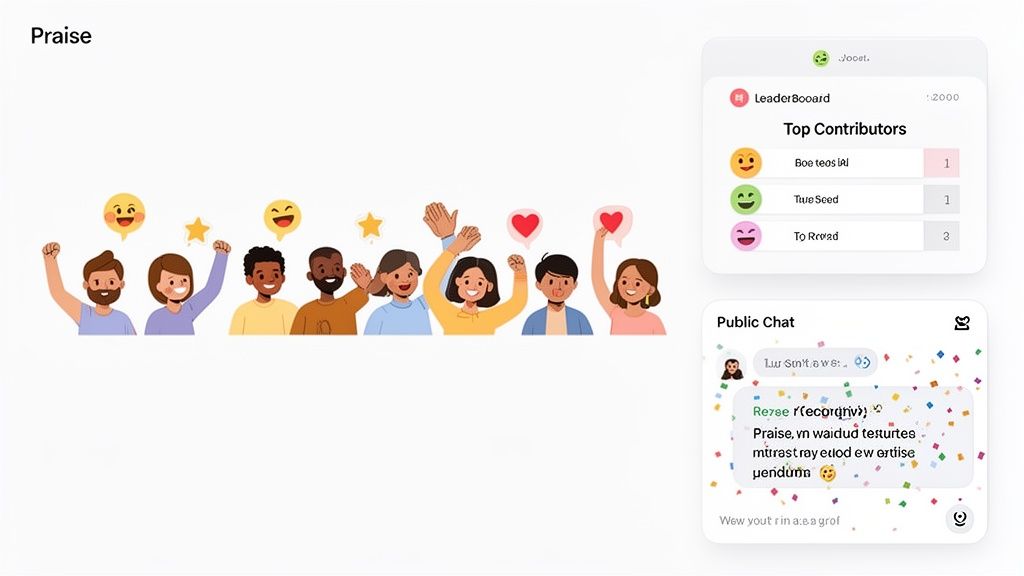
A simple "thank you" in a direct message is nice, but it's a missed opportunity. It does very little to build trust across the entire team. To truly weave recognition into your culture, it has to be specific, timely, and public. This transforms a private moment into a shared experience that reinforces your team's values and shows everyone what success looks like in action.
For instance, a generic "Thanks for your help on the report" is forgettable. A public shout-out in a team Slack channel, however, has a much bigger impact.
Practical Example: A Powerful Shout-Out
"Huge shout-out to @Sarah for catching that data discrepancy in the Q3 report! Her attention to detail saved us from a major headache and ensured we presented accurate numbers to leadership. That kind of diligence is exactly what we value as a team."
This single post does three things brilliantly: it recognizes Sarah’s competence, it defines a core team value (diligence), and it lets the whole team in on a behind-the-scenes win. Over time, these small acts of public praise build a powerful tapestry of trust and mutual respect.
Implementing Recognition Rituals in Slack
The secret to a lasting recognition culture is making it an easy, embedded habit—not another administrative task on someone's to-do list. This is where tools built for platforms like Slack really shine, turning appreciation into a seamless part of the daily workflow.
Using a tool like AsanteBot, you can create structured rituals that make peer-to-peer praise the norm. Instead of waiting for managers to say something, you empower everyone to celebrate their colleagues' wins.
Here are a few practical examples of how this works incredibly well:
- Create a Peer Praise Workflow: Get a dedicated
#kudoschannel going. You can even set up custom emoji reactions (like a sparkle ✨ or a trophy 🏆) to trigger a formal recognition event in an app. This makes giving praise ridiculously simple. - Launch Weekly Leaderboards: Gamify the process by celebrating the top givers and receivers of recognition each week. This not only encourages participation but also highlights the team's most active connectors and collaborators.
- Automate Milestone Celebrations: Never miss a work anniversary or birthday again. Set up automatic celebrations in a public channel to foster that sense of community and personal connection that remote teams crave.
The goal here is to lower the barrier to giving praise so it feels as natural as sending any other message. Once you have the right tools in place, finding the right employee appreciation phrases is the only thing your team needs to think about.
Impact of Recognition Frequency on Team Trust
The frequency of these recognition rituals has a direct and measurable impact on team trust. Moving from ad-hoc praise to a structured, daily habit significantly strengthens the bonds within a virtual team.
| Recognition Frequency | Impact on Peer-to-Peer Trust | Impact on Psychological Safety | Example Activity (in Slack) |
|---|---|---|---|
| Sporadic | Low: Trust remains siloed. | Low: Team members are hesitant. | A manager occasionally gives a shout-out in a team meeting. |
| Weekly | Moderate: Bonds start forming. | Moderate: Some risk-taking. | A dedicated "Wins of the Week" thread in the main team channel. |
| Daily/Real-Time | High: Trust is the default. | High: Vulnerability is encouraged. | A #kudos channel with real-time peer recognition triggered by emoji reactions or a simple bot command. |
As the table shows, making praise a daily, real-time activity is what truly moves the needle, transforming the team's entire dynamic.
The Measurable Impact of a Connected Team
Embedding these rituals does far more than just make people feel good; it directly boosts performance and cohesion. When recognition is a daily habit, it bridges communication gaps and provides the positive reinforcement needed to strengthen team bonds, no matter how many miles separate everyone.
The data backs this up. Over 80% of employers and employees agree that a strong sense of community at work is vital. More than that, teams that maintain consistent virtual engagement see a 25% increase in cohesion and a 20% productivity lift over three years. By making recognition a central part of your strategy, you’re investing in a more connected, effective, and resilient team.
Leadership Behaviors That Build Virtual Trust
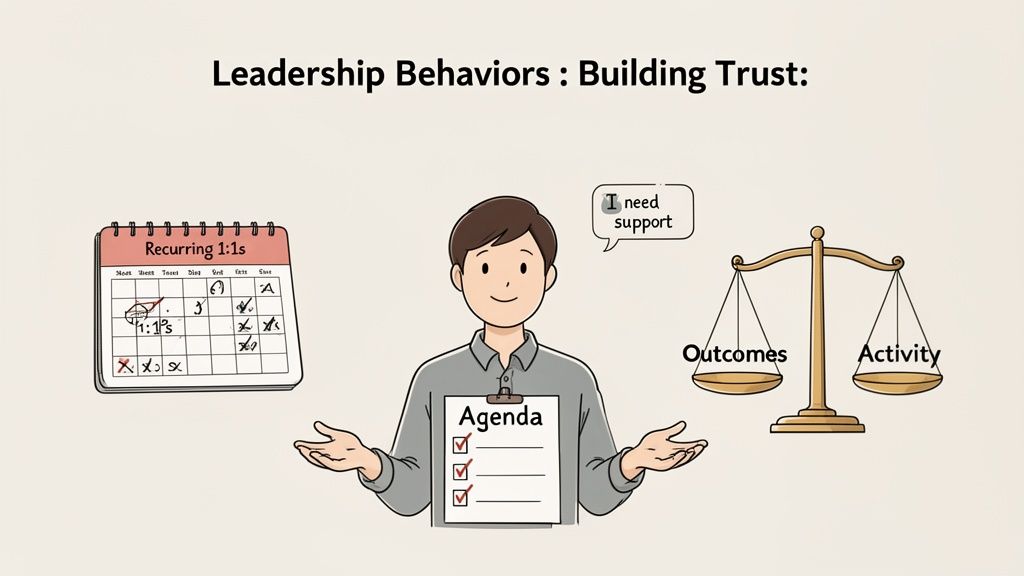
In a distributed team, trust isn’t a happy accident. It's a direct outcome of a leader's intentional, everyday actions. While things like peer recognition are great for building trust from the ground up, the biggest impact always comes from the top. A leader’s behavior is what truly sets the tone, creating the psychological safety and predictability the entire team depends on.
When you, as a manager, model the right behaviors, you make trust the default setting. Your actions—or lack thereof—send the loudest message about what your team actually values.
Lead with Vulnerability and Authenticity
Believe it or not, vulnerability is a massive trust accelerator. It's not a weakness. When you openly talk about your own missteps or admit you don't have all the answers, you instantly become more human. This gives your team the green light to be open and honest in return, which is the bedrock of real psychological safety.
A practical example is starting a team meeting by saying, "I tried a new approach for the project plan and it didn't quite work out as I'd hoped. Here's what I learned, and I'd love your ideas on how we can tackle it differently." This models humility and encourages a culture where mistakes are learning opportunities, not failures to be hidden. To get this right, it helps to ground yourself in a few essential leadership principles that form a strong foundation.
Create Predictable Communication Cadences
For a remote team, consistency is a form of respect. When communication from a leader is all over the place, it creates a low-grade hum of anxiety. People can't plan their work or feel secure if they don't know what to expect. A reliable rhythm is non-negotiable for building trust in virtual teams.
This doesn't have to be complicated. It starts with a few simple habits:
- Consistent 1-on-1s: Keep your weekly or bi-weekly one-on-ones sacred. Put them on the calendar and don't cancel unless it’s a true emergency. These meetings are your single most powerful tool for building individual trust.
- Structured Team Meetings: An agenda isn't optional. Send one out at least 24 hours in advance so everyone can show up prepared. It signals that you respect their time.
- Clear Response Times: Set expectations for communication. Let your team know how to reach you for urgent issues versus things that can wait.
This kind of predictability strips away ambiguity, freeing up your team to focus on great work instead of trying to read your mind.
A leader's consistency is the currency of trust. When your team knows what to expect from you, they feel safe, respected, and empowered to do their best work.
Empower Autonomy by Focusing on Outcomes
If you want to kill trust, start micromanaging. In a remote setting, it’s not just annoying—it’s a giant flashing sign that says, "I don't trust you." Instead of obsessing over online statuses or tracking every minute, the best remote leaders manage outcomes.
They give their teams clear goals and then get out of the way, trusting them to figure out the "how." This approach shows you have confidence in their skills and their commitment.
Practical Example: Handling a Missed Deadline
Imagine a team member misses a big deadline. A manager who erodes trust will immediately jump to conclusions and demand an explanation for every minute of their day. A trust-building leader, on the other hand, approaches the situation with curiosity.
- Trust-Building Approach: "Hey, I saw we missed the deadline on the project. Just wanted to check in and see if everything is okay. Let's find 15 minutes to chat about any roadblocks and figure out a new plan together."
This simple shift in tone changes everything. The conversation moves from blame to collaboration. It reinforces that you're a coach, not a cop. By managing the final result instead of the busywork, you build a culture of genuine accountability and mutual respect.
How to Measure Trust in Your Remote Team
Trust can feel like a fuzzy, intangible thing, especially when your team is spread out. But if you can't measure it, you can't improve it. The trick is to turn that feeling into something you can actually track, giving you a real-time health check on your team’s culture. It’s about blending the hard numbers (the "what") with the human stories (the "why").
This isn't just about collecting data for a dashboard. It’s about diagnosing the strength of your team's connections before small cracks turn into major fractures.
Start with the Hard Data
Numbers don't lie. They give you an objective baseline to see where things stand. While no single metric tells the whole story, a few key indicators can definitely point to underlying trust issues.
Here's what I recommend keeping an eye on:
- Voluntary Turnover Rates: Let's be honest, high turnover is the most expensive symptom of a low-trust environment. When great people keep heading for the door, it’s a massive red flag.
- Employee Net Promoter Score (eNPS): This one is simple but powerful. It asks, "How likely are you to recommend this company as a great place to work?" A low score often points directly to a lack of trust in leadership or peers. You can learn more about how to calculate and use eNPS to get a pulse on team loyalty.
- Participation in Virtual Events: Are people actually showing up for the non-mandatory stuff, like virtual coffee chats or game nights? If attendance starts to dip, it could mean people are feeling disconnected or that the events just aren't hitting the mark.
A Pro Tip: Look at Your Recognition Data
One of the most revealing data sources is hiding in plain sight: your team's recognition patterns. Tools like Asante have dashboards that show you exactly who is giving and receiving kudos. This helps you spot the natural connectors and influencers on your team.
For example, if you see praise flowing freely across the team but one person is consistently an island, that’s a sign. It could be a simple integration issue or a deeper trust gap that needs a manager's attention.
Get the Real Story with Qualitative Feedback
Numbers tell you what is happening, but you need qualitative feedback to understand why. This is where you get the context, the nuance, the human element.
Anonymous pulse surveys are fantastic for this. They create a safe space for people to share honest thoughts on things like psychological safety and team cohesion without feeling put on the spot. Just keep them short, send them out regularly, and focus on the core components of trust.
Sample Pulse Survey Questions
Asking the right questions is everything. Here are a few I've found to be really effective for getting at the heart of team trust. Feel free to adapt them.
- "On a scale of 1-5, how comfortable do you feel admitting a mistake to the team?"
- "How confident are you that your teammates have your back when things get tough?"
- "Do you feel that your unique skills and contributions are seen and valued by your colleagues?"
- "How often do you hesitate to ask for help because you're worried about being judged?"
The answers here will help you zero in on specific areas where trust is either flourishing or faltering. You can stop guessing and start creating targeted solutions that actually work.
And make no mistake, this isn't just a "nice-to-have" HR activity; it has a real financial return. The virtual team-building market has seen a 21.74% year-over-year increase for a reason. For every $1 companies spend, they report an average return of $4 to $6. Even better, organizations that invest more than $25 per person each month in these kinds of activities see 75% lower rates of poor morale. These investments clearly pay off.
Common Trust-Building Pitfalls to Avoid
Even with the best of intentions, it's surprisingly easy to erode trust in a remote team. Recognizing the common tripwires is half the battle. So many of these mistakes happen when leaders try to shoehorn old-school, in-office management tactics into a virtual world, and it just doesn't translate.
The Big Trust Killers
One of the fastest ways to kill morale is by using surveillance software disguised as productivity tracking. Monitoring keystrokes, mouse clicks, or snapping random screenshots sends a crystal-clear message: "I don't trust you to do your job." This toxic approach fixates on busywork instead of results, completely shattering psychological safety.
Another classic mistake is inconsistent leadership communication. When a manager is all over the place with updates or constantly cancels one-on-ones, it injects a ton of anxiety into the team. People start to feel out of the loop, wondering what they're missing, which directly attacks the reliability pillar of trust.
The Myth of "It'll Happen Naturally"
Maybe the most widespread pitfall is simply assuming trust will build itself. It won't. In an office, you get those casual "water cooler" moments, but remote relationships need to be built with purpose. A hands-off leadership style here doesn't foster autonomy; it fosters disconnection and silos.
You have to actively fight against the "out of sight, out of mind" instinct. This means putting systems in place that make every single person feel seen, heard, and valued, no matter where they're logging in from. The importance of team recognition here cannot be overstated; it's the most powerful tool for making sure effort is seen and appreciated, which is the antidote to feeling invisible.
Trust isn’t a default setting; it’s an outcome. It’s the direct result of consistent, intentional actions. Believing it will “just happen” is the surest way to guarantee it never will.
The Antidote: Focus on Results and Recognition
So, how do you steer clear of these traps? You have to fundamentally shift your focus from monitoring activity to celebrating achievements. Stop tracking hours and start tracking impact.
Here's a simple, preventative strategy that actually works:
- Ditch the surveillance tools. Seriously. Instead, set up a public Slack channel like
#winsor#progress-updates. Encourage everyone to post when they ship a feature, close a deal, or hit a key milestone. - Make recognition a daily habit. Champion peer-to-peer shout-outs for great work. This not only makes progress visible to everyone, but it also builds up a shared sense of competence and reliability. You're turning trust from an abstract idea into a public, celebrated value.
When you focus on the results and the people delivering them, you create a culture of accountability that's built on mutual respect, not fear. This is how you build trust in virtual teams that can weather any storm.
Got Questions About Building Trust Remotely?
When leaders start getting serious about building trust in their distributed teams, a few questions always seem to pop up. Here are my answers to the most common ones I hear.
How Can I Build Trust With A New Remote Hire, Fast?
Those first couple of weeks are everything. Ditch the standard HR checklist and design an onboarding experience that’s all about connection. Right away, pair them with an onboarding "buddy" who can answer all the informal, "silly" questions they might hesitate to ask a manager. Also, get several short, casual video chats on the calendar with different team members in that first week.
A great practical example of a first task is to have them create their own "user manual." It’s a simple document where they outline how they prefer to communicate and their typical work style. This gives the rest of the team a cheat sheet for working well with them from the get-go.
What’s the Biggest Mistake Leaders Make?
The most common trap is thinking trust will just build itself. It won't. In a remote setup, trust is something you have to design and build with intention—it doesn't just happen by osmosis like it might in an office. Leaders who take a passive, "wait-and-see" approach almost always end up with disconnected, siloed teams.
You have to be the architect. This means putting consistent rituals in place for communication, connection, and especially team recognition. The importance of team recognition is that it makes competence visible to everyone. For instance, a specific shout-out in a public Slack channel for a well-executed project does more to build trust than a month of radio silence ever could.
My Team Seems Disengaged. How Do I Fix It?
Disengagement is almost always a red flag for low psychological safety and weak interpersonal bonds. The fix is to start deliberately injecting small, consistent human moments back into your team's routine. Never underestimate the power of a simple five-minute, non-work check-in at the start of a meeting.
Focus on celebrating small wins publicly. When people feel seen and their work is valued, engagement naturally follows. A culture rich in recognition is a culture where people feel safe enough to fully invest themselves.
Try setting up a simple peer-to-peer praise system. A practical example would be creating a #kudos channel in Slack and encouraging everyone to post at least one thank you to a colleague by the end of each week. This takes the burden of recognition off your shoulders alone and empowers the entire team to build each other up. It creates a powerful, self-sustaining cycle of positive reinforcement that can completely turn things around.
Ready to make recognition a seamless, impactful part of your daily workflow? AsanteBot is a Slack app that helps you build a high-trust culture with peer-to-peer praise, automated celebrations, and insightful analytics. Start building a more connected team in just two minutes.