

Measuring team performance effectively isn't just about crunching numbers like project completion rates. It's about blending that hard data with the human side of work—things like peer feedback and how well everyone collaborates. The real goal is to ditch the dreaded annual review for a system that gives your team clarity, helps them grow, and actually recognizes their hard work.
Table of Contents
Why Traditional Performance Reviews Don't Work Anymore
We’ve all been there. A manager, let's call her Alex, spends weeks preparing for the annual review cycle. The whole process is sluggish, relies on subjective memories from months ago, and usually leaves her team feeling more deflated than inspired. If that sounds familiar, you're not alone.
The truth is, the old way of measuring team performance is broken. It's no longer about a once-a-year judgment day. Modern performance measurement is a continuous conversation designed to create clarity, align everyone's efforts, and truly unlock a team's potential.
A New Way to Think About Performance
The big idea is to mix data with genuine human insights. If you only look at metrics, you miss the nuances of teamwork and creative problem-solving. But if you only go with your gut, you open the door to bias and inconsistency. The magic happens right in the middle.
To really get a handle on this, digging into performance management best practices can give you a solid framework to build on.
This balanced approach helps everyone understand not just what they got done, but how they did it together. It turns a backward-looking critique into a forward-looking conversation about development.
The Power of Data-Backed Insights
Measuring team performance is now a data-driven discipline, and it’s critical for success. Take the case of a major tech company that started using a performance management platform to track key metrics in real-time. The result? A 20% jump in productivity. You can read more about these game-changing performance management metrics.
The goal isn't just to collect data. It's to use that data to tell a story about your team's journey—a story that celebrates wins, pinpoints roadblocks, and shines a light on where to go next.
Why Recognition is a Metric That Matters
Finally, let's talk about something that’s often missed: team recognition. When you tie appreciation to clear goals and visible contributions, it becomes an incredible motivator. It shows people their effort matters, reinforces the right behaviors, and makes the team stronger. Meaningful recognition isn't just a "nice-to-have"—it's an essential part of a high-performing culture because it provides positive reinforcement for the exact behaviors you want to encourage.
For example, a marketing manager might publicly praise their content team for a blog post that drove a 30% increase in qualified leads. By specifically mentioning the data-driven approach they took, the manager not only celebrates the win but also shows the entire team what successful, data-informed content creation looks like. This makes great teamwork repeatable.
Choosing Metrics That Actually Matter
It’s easy to get lost in a sea of data when you start thinking about team performance. The real challenge isn't tracking everything—it's tracking the right things. The goal is to find metrics that show how your team truly creates value, not just how busy they look. Forget generic, one-size-fits-all KPIs; this is about tailoring your approach to what makes your team tick.
To get there, you need a mix of two kinds of data: quantitative and qualitative. Think of them as telling you what happened and how it happened.
Balancing The "What" And The "How"
Quantitative metrics are your hard numbers. They're objective, straightforward to track, and give you a clear picture of output. For a customer support team, a key metric might be average ticket resolution time. For a sales team, it's often the number of closed deals per quarter. These numbers are non-negotiable for understanding efficiency and results.
But numbers on their own are only half the picture. Qualitative metrics fill in the gaps by measuring the "how"—the behaviors, skills, and teamwork that drive those results. They get at things like collaboration, innovation, and problem-solving. While they're trickier to pin down, this is often where you'll find the most powerful insights into your team's health and future potential.
Measuring only quantitative output is like judging a chef solely on how many dishes they make per hour. You miss the crucial elements of quality, creativity, and customer satisfaction that truly define their performance.
This concept map illustrates perfectly how data, insights, growth, and recognition all feed into one another to build a comprehensive view of team performance.
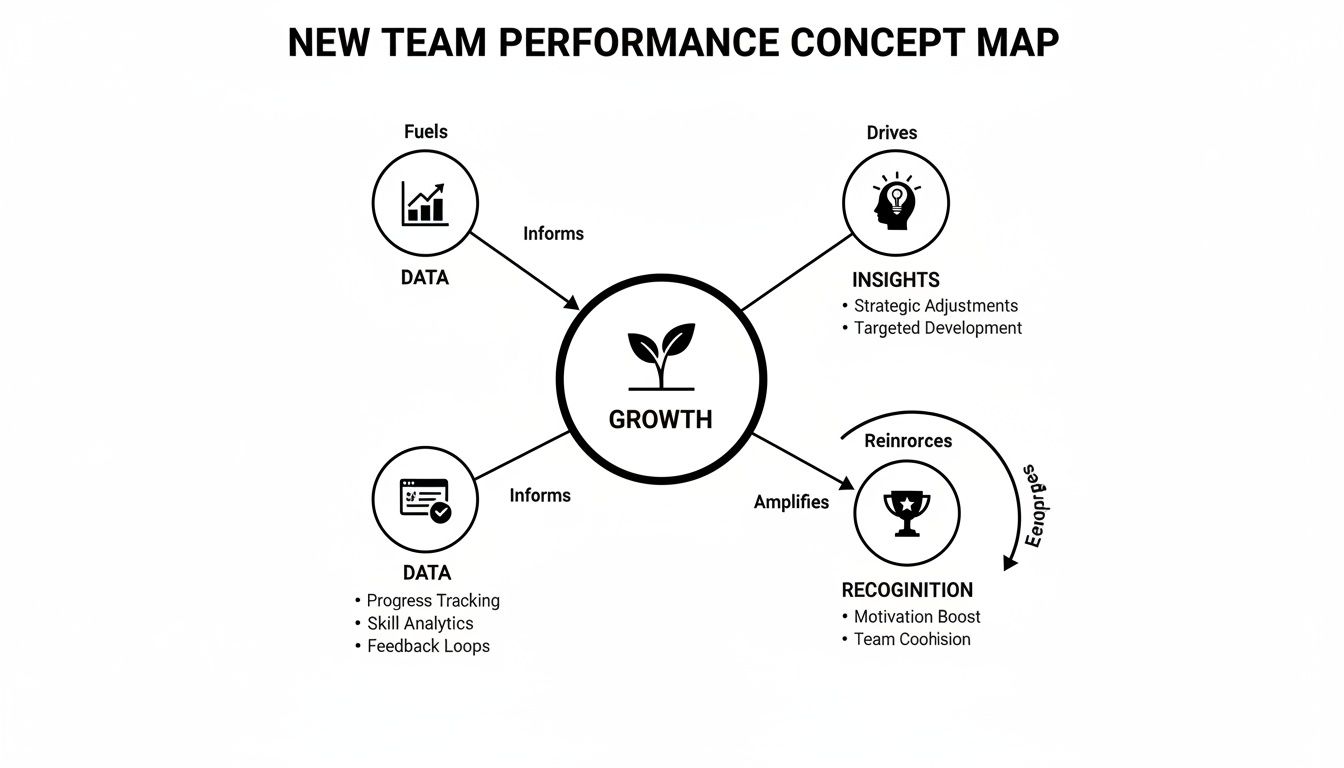
As you can see, raw data is just the starting point. The real magic happens when you turn that data into actionable insights that fuel both team growth and genuine recognition.
A Look at Quantitative vs. Qualitative Metrics
To get this balance right, it helps to see how these metrics apply to different teams. A KPI that’s invaluable for a sales team might be completely irrelevant for your engineers.
Here’s a breakdown to help you pick the right blend for your crew:
| Metric Type | Description | Example for Sales Team | Example for Engineering Team | Example for Marketing Team |
|---|---|---|---|---|
| Quantitative | Objective, numerical data that measures outputs and efficiency. It answers "what" or "how many." | Conversion Rate (e.g., leads to customers) | Cycle Time (time from first commit to production) | Cost Per Acquisition (CPA) |
| Qualitative | Subjective, descriptive data that measures qualities and behaviors. It answers "why" or "how." | Quality of Customer Interactions (from call reviews) | Peer Code Review Feedback | Brand Sentiment Analysis |
Choosing a mix of both types gives you a far more accurate and human-centric view of performance than just sticking to the numbers.
Crafting Metrics for Specific Teams
Generic metrics just don't cut it. To be meaningful, your KPIs have to connect directly to what your team does day-in and day-out. An engineering team's goals are fundamentally different from a marketing team's, and their metrics should reflect that.
Let’s get practical with a few examples:
- For an IT Support Team: Don't just count the number of tickets closed. A much better metric is the First Contact Resolution (FCR) Rate. This tells you how often the team solves an issue on the first try, which is a massive driver of user satisfaction.
- For a Sales Team: Instead of only looking at total revenue, track the Qualified Lead to Opportunity Ratio. This shows how effectively the team is turning promising leads into real pipeline opportunities—a leading indicator of future success.
- For an Engineering Team: Please, don't use "lines of code." A far superior metric is Cycle Time, which is the time it takes to get work from "in progress" to "deployed." It’s a direct measure of efficiency and delivery speed. If you want to go deeper, this guide on Engineering Performance Indicators is a great resource.
How to Measure The "How"
So, how do you actually measure something that feels as subjective as collaboration or morale? You tap into qualitative data sources that capture team sentiment and interaction.
Peer feedback is an incredibly rich source of this data, especially when it’s gathered within the flow of work. For teams on Slack, recognition becomes a powerful, organic metric. When you see colleagues constantly shouting someone out for "always being helpful" or "coming up with creative solutions," you're getting real-time, qualitative proof of high performance.
Another fantastic tool is the Employee Net Promoter Score (eNPS), which is a simple way to gauge team loyalty and engagement. To get the full scoop, check out our guide on https://asantebot.com/blog/what-is-employee-net-promoter-score/ and how it can give you a quick pulse on your team's morale.
Don't Overlook Recognition as a Metric
Recognition isn't just a "nice to have"—it’s a critical data point. The specific praise people give each other highlights the exact behaviors you want to see more of. See a team member getting frequent kudos for mentoring others? You've just identified an emerging leader. Notice a project getting praise from multiple departments? That's what effective cross-functional collaboration looks like in the wild.
By keeping an eye on recognition patterns, you can:
- Spot the true influencers: Pinpoint the people who are the connective tissue of your team.
- See your values in action: Check if the behaviors being celebrated actually line up with your company's core values.
- Catch engagement dips early: A sudden drop in peer-to-peer recognition can be a red flag for declining morale or burnout.
Ultimately, picking the right metrics is about creating a balanced scorecard—one that reflects both the results your team delivers and the way they work together to get there. This holistic view is the only way to measure performance in a way that truly drives improvement and builds a culture people want to be a part of.
Choosing the Right Tools to Gather Performance Data
Okay, so you've figured out what you want to measure. Now comes the tricky part: actually gathering that data without making your team feel like they're spending all day filling out forms. The right tools are everything here. They can make this whole process a seamless, consistent part of your workflow instead of a dreaded administrative chore.
Modern platforms can pull in the data you need automatically, giving you incredible insights without all the manual legwork.

Capturing Quantitative Data in the Flow of Work
When it comes to the "what"—your hard numbers—your project management software is your best friend. These tools are absolute goldmines of objective data on output, efficiency, and deadlines, all tracked automatically as your team gets work done.
Here’s how I’ve seen this work best:
- For engineering teams: Tools like Jira or Azure DevOps are invaluable. You can pull reports on things like cycle time, sprint velocity, and bug resolution rates right out of the system. This gives you a crystal-clear, data-backed view of your team's delivery pace and quality.
- For project-based teams: If you're using Asana, Trello, or Monday.com, you already have visibility into on-time completion rates, task throughput, and project milestones met. Set up a simple dashboard to see which projects are cruising and where bottlenecks are starting to form.
The whole point is to use the data these tools are already generating. Don’t ask your team to manually update another spreadsheet. That just adds noise and guarantees the information will be out of date.
Gathering Qualitative Insights Through Human Connection
Now for the "how." Qualitative data is where you uncover the story behind the numbers. This is all about behaviors, collaboration, and individual growth, and it requires a more personal touch.
Structured conversations and feedback loops are your primary tools here.
- Structured One-on-Ones: These need to be more than just casual catch-ups. Use a shared agenda to discuss progress, roadblocks, and what’s next for them. I find asking open-ended questions like, "What part of your work felt most energizing this week?" uncovers way more about engagement than a simple "How's it going?"
- 360-Degree Feedback Surveys: When they're run well, these can provide a fantastic, well-rounded view of an individual’s impact. Making them anonymous usually encourages more honest feedback on things like collaboration and communication skills from peers, reports, and managers.
- Self-Assessments: Simply asking team members to reflect on their own performance against their goals is powerful. It builds ownership and can bring personal challenges or successes to light that you might have otherwise missed.
Using Modern Tools for Real-Time Feedback
The real game-changer in performance measurement today is the ability to capture this qualitative data in real-time, right where your team is already working. This is where tools built for platforms like Slack truly shine.
For instance, an app like AsanteBot lets you see peer recognition as it happens. When a developer gives a public shout-out to a designer for helping them unblock a tough UI problem, that's a tangible piece of qualitative data. It’s a live indicator of strong collaboration.
This kind of organic, in-the-moment recognition is so much more authentic and impactful than a forced, quarterly feedback session. Team recognition is critically important because it reinforces the collaborative behaviors that lead to success, boosting morale and making positive actions contagious.
By integrating recognition into your daily workflow, you transform it from an occasional event into a continuous stream of performance data. You start measuring the very behaviors that build a high-performing culture.
This shift is having a massive impact. Organizations using AI-assisted performance reviews report a 71% increase in employee engagement, a 50% boost in goal achievement rates, and a 33% reduction in bias in evaluations. You can dig into more of these eye-opening performance management statistics if you're curious.
Ultimately, your toolkit should make gathering data feel effortless. When you combine the hard numbers from your project management software with the human insights from structured conversations and real-time recognition tools, you get a complete, balanced picture of how your team is truly doing. This blend of quantitative and qualitative is the foundation for turning data into truly meaningful developmental conversations.
Turning Data into Developmental Conversations
Collecting performance data is a lot like gathering ingredients for a recipe. The real magic isn’t just having the ingredients on the counter; it’s in how you combine them to create something meaningful. Raw numbers on a dashboard are just a starting point. The true value comes when you use that data to spark supportive, forward-looking conversations that actually help your team grow.
The whole point is to move past simply reviewing past mistakes. Instead, you want to use the data to create a sense of shared ownership. When your team sees metrics as a tool for solving problems—not a stick to be beaten with—they become genuinely invested in improving their own performance.
From Raw Numbers to a Compelling Story
Isolated metrics almost never tell the whole story. A dip in one KPI might look alarming on its own, but when you start connecting it to other data points, a much clearer picture emerges. Your job as a leader is to be a bit of a data detective, looking for patterns and connecting the dots between the hard numbers and the human element.
Let’s take a real-world example. Imagine your customer support team’s CSAT scores (a quantitative metric) have dropped by 10% over the last quarter. Looking at that number alone might lead you to assume the team is just not performing well.
But what happens when you cross-reference this with your qualitative data? Maybe you notice in your peer recognition data from a tool like AsanteBot that shout-outs for "cross-team collaboration" have plummeted. All of a sudden, the issue isn't just about individual performance; it's about a breakdown in the internal support systems your team relies on.
A single metric is a snapshot, but a combination of metrics tells a story. That dip in CSAT scores isn't the problem itself; it’s a symptom. The real story is that your support team might not be getting the timely help they need from other departments, leading to longer resolution times and, naturally, frustrated customers.
This insight completely changes the conversation. Instead of asking, "Why are your scores down?" you can now ask, "How can we improve the support you're getting from the engineering team?" This simple shift transforms a potentially accusatory review into a collaborative problem-solving session.
Building Simple, Actionable Dashboards
You don’t need a fancy, expensive business intelligence tool to start seeing these trends. Honestly, a simple, well-designed dashboard can be incredibly effective for spotting patterns and sharing insights with your team. The trick is to keep it focused on the few metrics that actually matter.
A great dashboard for your team should probably include a mix of:
- Outcome Metrics: These are your big-picture KPIs, like
Project On-Time Delivery RateorMonthly Recurring Revenue. They tell you if you're winning. - Process Metrics: These track the "how," or the efficiency of your team’s workflow. Think
Average Cycle TimeorFirst Contact Resolution Rate. - Qualitative Indicators: This could be a simple chart tracking the volume of peer-to-peer recognition or highlighting key themes from your latest employee pulse surveys.
By putting these different types of data side-by-side, you make it so much easier for everyone to see how they influence one another. It becomes a shared source of truth that your whole team can rally around.
Framing Developmental Conversations
Once you have your insights, the most critical step is how you bring them to the team. The way you frame the conversation will determine whether it inspires growth or just creates defensiveness. Your goal should always be to look forward, not to punish people for the past.
Here are a few practical tips I've learned for turning data into a powerful developmental tool:
- Lead with Curiosity. Don't start with an accusation. Present the data and ask open-ended questions. Instead of saying, "Your code review turnaround time has slowed down," try something like, "I noticed our cycle time has increased a bit. What are some of the roadblocks you’re running into lately?"
- Focus on Trends, Not Incidents. Avoid fixating on a single bad day or a one-off mistake. It happens. Look at the data over weeks or months to talk about the bigger patterns. This keeps the conversation strategic and high-level, rather than reactive and nit-picky.
- Celebrate the Wins. Performance conversations shouldn't be all doom and gloom. They should also highlight what's going right! Use that recognition data to kick things off on a positive note. For example, "The team has been getting a ton of praise for their innovative solutions on the new feature. How can we apply that same creative energy to our backlog?"
Ultimately, this process turns performance measurement from a top-down evaluation into a collaborative cycle of learning and getting better together. When data is used to shine a light on challenges and celebrate successes, it becomes an incredible catalyst for building a smarter, more resilient team.
Weaving Recognition into Your Performance Fabric

Once you’ve turned raw data into meaningful conversations, the final piece of the puzzle is something that truly fuels momentum: recognition. All too often, appreciation is treated as a fluffy extra, a "soft skill" completely separate from the hard numbers. This is a massive missed opportunity.
Recognition isn't just about making people feel good; it's a powerful tool in the performance cycle. When you directly connect acknowledgment to the specific behaviors and outcomes you’re measuring, you create a powerful feedback loop. Great work gets seen, celebrated, and, most importantly, repeated. The importance of team recognition cannot be overstated; it builds morale, reinforces company values, and creates a culture where people feel seen and are motivated to do their best work.
Moving Past the Empty Compliment
Let’s be honest, the dusty "employee of the month" plaque isn't fooling anyone. To be effective, recognition has to be specific, timely, and authentic. It's about getting past generic praise and highlighting the exact contribution a person made and the impact it had.
So instead of a quick "Great job on the project," try something that really lands. For instance: "Sarah, your deep dive into the user feedback data was the key to us nailing that critical bug before launch. You just saved the team weeks of post-release headaches." That level of detail shows you’re actually paying attention and helps everyone else on the team see what excellence looks like in practice.
This is more important than ever. With global employee engagement sitting at an alarmingly low 21%, something has to change. The data shows that teams managed by engaged leaders see up to 18% higher engagement and perform 20–28% better. Recognition is a direct line to that kind of leadership.
Practical Ways to Build a Culture of Appreciation
Building recognition into your team’s culture doesn't need to be a complex, expensive initiative. It’s really about building small, consistent habits that become part of your team's DNA.
Here are a few ways to get started right away:
- Peer-to-Peer Shout-Outs in Slack: This is one of the easiest and most effective methods out there. Set up a dedicated Slack channel where team members can publicly recognize each other. A tool like AsanteBot can formalize this, making it simple for colleagues to give props and turn gratitude into a visible, everyday habit.
- Kick Off Meetings with Wins: Carve out the first five minutes of your weekly team meeting to celebrate wins—big or small. Did someone ship a major feature? Awesome. Did someone else navigate a really tough customer support ticket? Celebrate that, too. Making this a regular part of your agenda turns recognition into an expected rhythm.
- Connect Big Wins to Tangible Rewards: For those huge accomplishments, tie the praise to a reward that genuinely matters to the team. This could be anything from a team lunch at their favorite spot to professional development funding or even just extra time off. The key is that the reward acknowledges the group effort.
When recognition is public and tied to specific actions, it does more than just reward one person. It sets a clear example for the entire team, showing them precisely what kind of work is valued and creating a blueprint for future success.
Recognition in the Real World: A Quick Story
I once worked with a manager, let's call him David, who was struggling with a disengaged software team. Their velocity metrics were tanking, and you could feel the low morale in their daily stand-ups. Instead of hammering them on the numbers, he tried a different approach.
He created a #wins channel in Slack and made a point to start every single day by posting a specific shout-out to someone. He celebrated the dev who refactored a gnarly piece of legacy code, the QA engineer who found an obscure but critical bug, and the designer who collaborated brilliantly to simplify a user flow.
At first, it was just him. But slowly, others started joining in. Peer-to-peer recognition became the norm, not the exception. Within three months, the shift was undeniable.
- Project velocity jumped by 15% because people were more motivated.
- Cross-functional collaboration improved because those positive interactions were being constantly reinforced.
- Team morale was visibly higher, a change that was later confirmed in their next pulse survey.
David didn't just demand better performance; he created an environment where great work was impossible to miss. If you're looking to build something similar, checking out different employee recognition program examples can be a great source of inspiration. This just goes to show that recognition isn't an afterthought—it's a core strategy for unlocking what your team is truly capable of.
Got Questions About Measuring Team performance?
Putting a performance framework into practice is never a one-size-fits-all deal. Once you start, you'll inevitably run into unique situations and tricky questions. That's perfectly normal.
The goal isn't to follow a rigid process that clashes with how your team actually works. It's about adapting. Let's dig into some of the most common questions I hear from leaders who are trying to get this right.
How Do I Measure a Remote or Hybrid Team?
When your team isn't sharing an office, the old rules go out the window. You have to stop worrying about visible activity—like butts in seats—and focus entirely on tangible outcomes. In a distributed world, trust is everything, and measuring results is how you build and maintain that trust.
A great place to start is with a clear goal-setting framework like OKRs (Objectives and Key Results). This gives everyone, no matter their time zone, a crystal-clear picture of what success looks like for the quarter. You can use your project management tools like Asana or Jira to see progress against those specific deliverables, not to micromanage hours logged.
Then, you have to get intentional about communication. Those weekly one-on-ones over video calls? Make them non-negotiable. They are your best shot at coaching, giving meaningful feedback, and finding out what's really blocking progress. For the day-to-day stuff, digital tools like AsanteBot in Slack are fantastic for asynchronous feedback and real-time recognition. This whole approach shows you care about what your team produces, not just when they happen to be online.
Team Performance vs. Individual Performance
This is a really important distinction, and it's one where a lot of managers get tripped up.
Individual performance is all about a single person's contributions and their progress toward their own goals. Team performance, on the other hand, is the collective result—it’s about how well all those individuals work together to hit a shared objective.
Think of it like a pro basketball team. You can have five all-stars on the court, each with incredible individual stats. But if they don't pass the ball, communicate on defense, or trust each other's instincts, they can still get crushed by a less talented but more cohesive team.
High individual performance doesn't automatically equal high team performance. That's why you have to measure both. Use individual metrics for career growth conversations and personal development. But also track team-level metrics—things like project velocity, collective goal achievement, or customer satisfaction scores—to see if the whole is truly greater than the sum of its parts.
How Often Should I Review Performance?
If you're still relying on the dreaded annual review, it's time for a change. The most effective leaders have moved to continuous performance management, which is far less about formal evaluation and much more about ongoing coaching. This makes performance conversations a normal, helpful part of the workflow instead of a stressful, once-a-year event.
This really just means shifting to a more natural, agile rhythm:
- Weekly or Bi-weekly One-on-Ones: These are for real-time coaching, clearing small roadblocks, and just generally staying in sync.
- Quarterly Check-ins: A slightly bigger-picture chat to review progress against larger goals (like OKRs) and adjust the plan for the next quarter.
This rhythm allows you to course-correct in the moment and builds a culture where everyone is constantly learning. When you do have a more formal annual summary, there should be zero surprises. It's just a recap of all the supportive conversations you've been having all year long.
How Can I Measure Performance for Creative Roles?
This one's a classic. Measuring performance for designers, writers, or marketers can feel a bit like trying to bottle lightning. The key is to stop trying to measure the creativity itself and start measuring the impact of that creativity. You do this by mixing qualitative and quantitative data.
You can't put a number on a brilliant design concept, but you can absolutely measure its effects. Look for quantitative metrics like:
- Concept Approval Rate: How often are first-pass concepts hitting the mark without needing major overhauls?
- Client Satisfaction Scores (CSAT): Ask clients for direct feedback on the quality of the creative work.
- Campaign Engagement Metrics: Track the clicks, shares, and conversions that a creative campaign actually generated.
Then, you need to pair that hard data with rich, qualitative feedback. 360-degree reviews are perfect for this, as peers and stakeholders can comment on specific behaviors like collaboration, innovation, and how well the creative output aligned with the project's strategic goals. This combination gives you a much more complete picture that honors both the art and the science of creative work.
Ready to make recognition a measurable part of your performance strategy? AsanteBot makes it easy to build a culture of appreciation right within Slack. See how real-time peer recognition can boost morale and provide powerful insights into your team's health. Start your free trial today and turn everyday gratitude into a habit that drives results.