

The Employee Net Promoter Score, or eNPS, is a straightforward way to gauge how your employees really feel about working at your company. It boils down to one simple question: how likely are they to recommend your organization as a great place to work?
Table of Contents
Think of it as the ultimate "word-of-mouth" test for your company culture. It’s a quick pulse check that tells you a lot about employee loyalty and engagement.
Defining Your Internal Word of Mouth
So, what exactly is the Employee Net Promoter Score?
Let’s use an analogy. Imagine your company is a new restaurant. Some people who dine there will love it so much they’ll rave about it to all their friends. These are your Promoters. Others will think the food was fine but won't rush to recommend it. They're your Passives. And then there are those who had a genuinely bad time and will actively tell people to stay away. These are your Detractors.
eNPS takes this exact same concept and applies it to your team. It’s a departure from long, complex satisfaction surveys with vague scales. Instead, it uses a simple 0-10 scale to get a clear, honest read on how people feel. You can learn more about the core eNPS methodology from BambooHR.
Based on their answer, every single employee is sorted into one of these three groups.
Promoters, Passives, and Detractors
Getting to know these three categories is the key to turning your eNPS score into real, meaningful action. Each group gives you a different piece of the puzzle about your company culture and overall employee experience.
-
Promoters (Score 9–10): These are your champions. They're not just happy; they're actively engaged, motivated, and serve as fantastic brand ambassadors. Think of a software developer who's so thrilled with the company's vision and her growth path that she's constantly encouraging talented friends in her network to apply.
-
Passives (Score 7–8): This group is sitting on the fence. They’re satisfied enough to stay, but they aren't emotionally invested or enthusiastic. A passive employee might like their salary and their immediate team but doesn't feel a strong connection to the company's mission. They’re also the most likely to be tempted by a better offer from a competitor.
-
Detractors (Score 0–6): These are your unhappy employees. Their disengagement can be toxic, often dragging down team morale and productivity. A detractor might be someone who complains openly about processes, shows frustration in meetings, or even leaves negative reviews on sites like Glassdoor, actively damaging your employer brand.
To help you keep these groups straight, here’s a quick breakdown:
eNPS Employee Categories at a Glance
| Category | Score Range | What It Means |
|---|---|---|
| Promoter | 9–10 | Your most enthusiastic and loyal employees. They are brand ambassadors. |
| Passive | 7–8 | Satisfied but not engaged. They are neutral and vulnerable to competitors. |
| Detractor | 0–6 | Unhappy and disengaged. They may spread negativity internally and externally. |
Understanding these distinctions is everything. The importance of team recognition, for example, cannot be overstated. A simple act of appreciation can be the very catalyst that shifts a neutral Passive into a vocal Promoter, demonstrating that small gestures often have the biggest impact on employee loyalty.
Calculating and Understanding Your eNPS Score
So, you've got your three groups of employees: the Promoters, the Passives, and the Detractors. Now, let’s get down to the brass tacks of how those groups translate into a single, powerful number. The beauty of the Employee Net Promoter Score is its simplicity, but don't let that fool you—understanding what your score really means is where the magic happens.
The eNPS calculation is designed to give more weight to the strongest feelings in your organization, pitting your biggest fans against your most unhappy team members to give you a clear snapshot of employee sentiment.
The Simple eNPS Formula
Calculating your score is straightforward. You just take the percentage of your Detractors and subtract it from the percentage of your Promoters.
The formula is: eNPS = % Promoters – % Detractors
What about the Passives? They're intentionally left out of this equation. Their neutrality doesn't actively help your score, but it doesn't drag it down either. They represent untapped potential, which is a story for later.
This formula gives you a score that can fall anywhere between -100 (if every single employee is a Detractor) and +100 (if everyone's a Promoter). It’s a clean metric that cuts through the noise of more complicated surveys.
Let's walk through a real-world example. Imagine you survey 200 employees at your company:
- 100 employees give a 9 or 10. They’re your Promoters (50%).
- 60 employees give a 7 or 8. They’re your Passives (30%).
- 40 employees give a score from 0 to 6. They’re your Detractors (20%).
Now, plug those numbers into the formula: 50% (Promoters) – 20% (Detractors) = +30.
Just like that, your eNPS score is +30.
This visual guide breaks down how each employee category contributes to that final number.
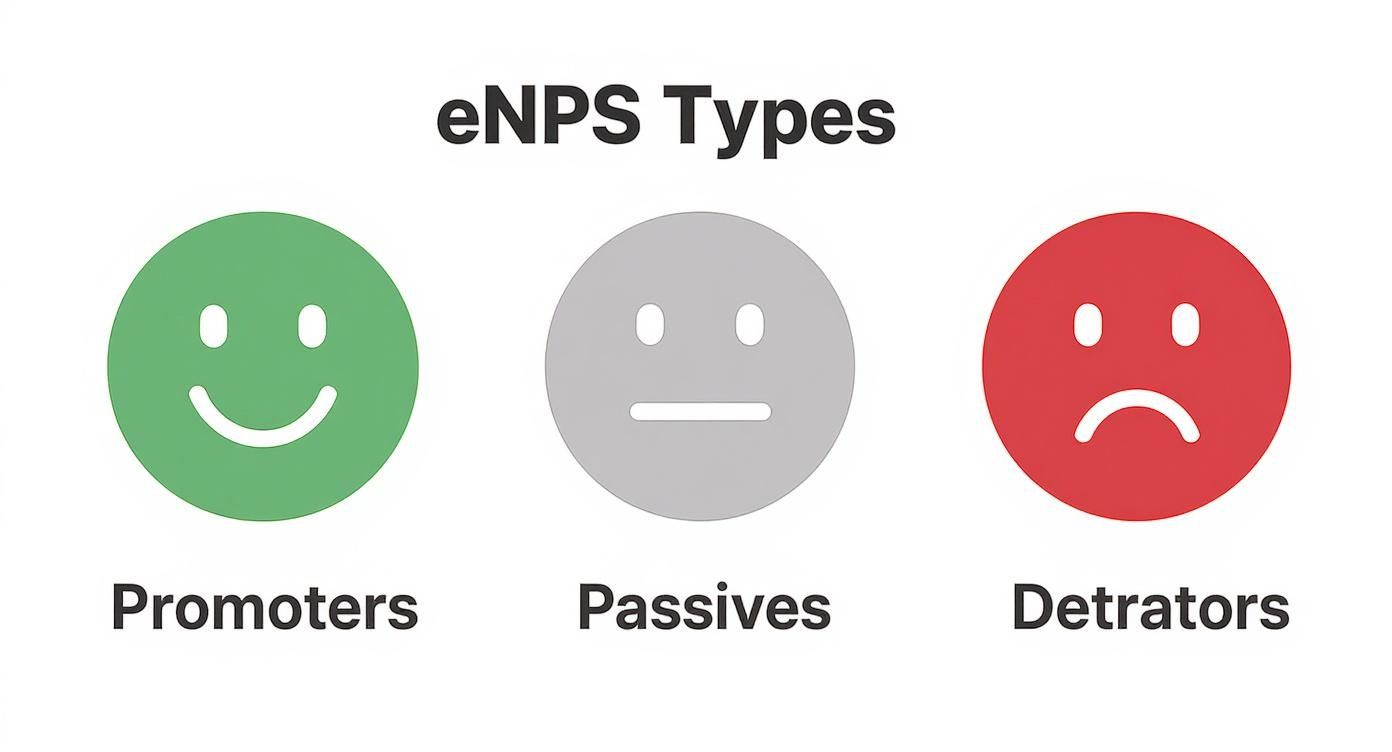
As the infographic shows, Promoters are the engine pushing your score up, while Detractors pull it down. The Passives? They’re sitting on the sidelines, waiting to be convinced.
What Is a Good eNPS Score?
A score of +30 sounds pretty good, but is it? The answer is, it depends. Context is everything. While any score above zero is a win (meaning you have more advocates than critics), here's a rough guide to help you interpret your result:
- Below 0: This is a major red flag. A negative score means Detractors outnumber Promoters, pointing to deep-seated issues with morale or culture that need immediate attention.
- Between 0 and 30: You're on solid ground. You have a decent foundation of employee loyalty, but there's a huge opportunity to turn those neutral Passives into passionate Promoters.
- Above 30: This is where you want to be. A score in this range suggests you’ve built a strong, positive culture where people feel valued and are happy to sing your praises.
Keep in mind, though, that benchmarks can swing wildly from one industry to another. The average eNPS across all sectors is around 12. The tech industry often reports higher scores, while the healthcare sector averages a concerning -6.5, reflecting just how much work environments can affect employee happiness. You can explore more eNPS benchmarks by industry to get a better sense of how you stack up.
The Importance of Team Recognition in Your Score
If you're looking for one of the most effective ways to boost your eNPS, look no further than team recognition. People want to feel seen and appreciated for their hard work. It’s human nature, and it's a powerful driver of loyalty. When employees feel their contributions matter, they become more invested in the company's success.
Think about it with a practical example. Imagine a product team pulls a few all-nighters to ship a critical feature on time. Most are probably feeling like Passives—satisfied they got it done, but also exhausted and wondering if their extra effort went unnoticed. If their manager posts a shout-out in a company-wide channel, celebrating the launch and tagging the key contributors, that changes everything.
That small, public act of recognition validates their hard work, builds morale, and creates the kind of loyalty that turns Passives into Promoters. On the flip side, ignoring their effort makes them feel like a cog in the machine, risking that those same Passives quietly slip into the Detractor camp over time. It’s that simple.
Why eNPS Is More Than Just a Number
So you've run your survey and calculated your score. Maybe it's a +15, maybe it's a -5. It’s easy to look at that number and see it as just another metric to plug into an HR dashboard. But that would be a huge mistake.
Your eNPS score is a powerful window into the health of your entire company. It tells a story about your culture, the effectiveness of your leadership, and even where your business is headed. Think of it like a check engine light for your organization—it’s not just a blinking light; it’s a signal that something deeper needs your attention. That’s why it’s often considered one of the most vital Human Resource KPIs for getting a real pulse on employee sentiment.
A high score isn't just for bragging rights. It's directly tied to real-world business results.
The Ripple Effect of Promoters
Your Promoters are so much more than satisfied employees. They’re your biggest champions, both internally and externally. These are the people who consistently go the extra mile, driving innovation and providing the kind of outstanding service that creates fiercely loyal customers.
Picture a Promoter on your customer support team. They don't just close a ticket. They take the time to truly listen, understand a customer's frustration, and find a solution that leaves that person feeling genuinely happy. That single interaction boosts customer retention. In engineering, a Promoter is the one mentoring junior developers, bringing fresh ideas to the table, and pushing for better standards, lifting the entire team's performance.
They are your best recruiters, too, attracting top-tier talent simply by sharing their authentic enthusiasm for their work.
The Hidden Costs of Detractors
On the other side of the coin, Detractors create a slow, quiet drag on your business from the inside out. Their disengagement is contagious. It shows up as missed deadlines, uninspired work, and a general negativity that can poison a team’s atmosphere.
Think about a Detractor on the sales team. Their skepticism about a new product will inevitably bleed into their calls, shaking a potential customer's confidence and losing you a sale. It’s not just anecdotal, either. The data consistently shows that disengaged employees lead to higher rates of absenteeism and turnover. Gallup estimates this lost productivity costs the global economy an eye-watering $8.9 trillion.
Detractors don't just underperform; they actively degrade the work environment for everyone else. Their negativity can drain team morale, increase workplace conflict, and damage your employer brand through word-of-mouth or negative online reviews.
eNPS as a Proactive Cultural Tool
This is where the real power of what an employee net promoter score is comes into play. It's not just a report card on how you've done in the past; it’s a predictive tool that lets you manage your culture and head off problems before they escalate.
By tracking eNPS over time, you can spot a worrying dip in a specific department and step in before a great team turns toxic. Is a new manager struggling to connect? Is a team feeling completely burned out after a major project? These issues surface in your eNPS data long before they start showing up in your resignation numbers.
This is why the importance of team recognition is so critical. A simple, genuine "thank you" can be the very thing that stops a quiet Passive from slipping into becoming a resentful Detractor. For example, celebrating a small win, like a junior marketer successfully launching their first ad campaign, makes that person feel seen and appreciated. It reinforces their connection to the mission and reminds them their work actually matters. It’s these small, consistent acts that build the psychological safety needed to cultivate a team full of Promoters.
Actionable Strategies to Improve Your eNPS
An eNPS score is a fantastic diagnostic tool, but let's be honest—a number by itself doesn't change a thing. Its real power comes from the action it inspires.
This is where you shift from just measuring to actually managing. The goal is to understand the story behind that number and make genuine improvements that build a healthier, more engaged workplace.
The very first step is to dive into the qualitative feedback. Those open-ended comments that people leave alongside their scores? That’s where the gold is. The "why" is always more insightful than the "what." By digging into what your Promoters, Passives, and Detractors are saying, you can pinpoint the real drivers of loyalty and dissatisfaction.
Uncover Themes in Your Feedback
It's tempting to see every piece of feedback as a one-off comment, but that’s a mistake. The key is to zoom out and look for the patterns. Are multiple Detractors bringing up a lack of career growth? Are your Promoters all raving about their direct managers?
Systematically grouping this feedback will quickly reveal your company’s core strengths and its most glaring weaknesses.
-
Promoter Feedback: Think of this as your playbook for what’s working. What do your most enthusiastic employees absolutely love about their job? Maybe it's the supportive team vibe, flexible work policies, or challenging projects. These are the things you need to protect and replicate across the company.
-
Detractor Feedback: This is a gift, even if it stings a little. It points you directly to the issues causing people to check out. Common themes often circle back to poor communication, feeling undervalued, or frustration with clunky internal processes. Tackling these issues head-on is the quickest way to stop your best people from heading for the door.
-
Passive Feedback: Pay close attention here. This group often gives you the most nuanced insights into areas that are just "okay" but could be "great." You might hear things like, "The work is fine, but I'm not really sure what the company's long-term vision is." That’s a crystal-clear signal that you need to get better at communicating your strategy.
Build a Feedback-Driven Action Plan
Once you've spotted the key themes, it's time to act. A classic mistake is trying to boil the ocean and fix everything at once. Don’t do it. Instead, pick two or three high-impact areas that will make the biggest difference for the most people.
For example, if a lack of recognition keeps popping up in Detractor and Passive comments, your action plan should be all about making appreciation a more visible and consistent part of your culture. This isn't just about launching another program; it's about building a sustainable habit.
An action plan without clear ownership and timelines is just a wish list. Assign specific leaders to champion each initiative and set target dates for implementation. Be transparent, too—share your plan with employees to show them you listened and are serious about making a change.
This approach does more than just fix the root problems. It builds trust by showing that employee voices actually lead to real, tangible action.
The Power of Team Recognition
Of all the things you can do to improve your eNPS, one strategy consistently delivers the biggest bang for your buck: team recognition.
Feeling valued is a fundamental human need. When people feel like their contributions are seen and appreciated, their loyalty skyrockets. A strong culture of recognition is the most effective engine for turning your ambivalent Passives into enthusiastic Promoters. Why is it so important? Because it reinforces positive behaviors, boosts morale, and shows employees that their individual effort contributes to the bigger picture.
And it doesn't have to be complicated or expensive. In fact, the most meaningful gestures are often simple, timely, and specific.
Here are a few practical examples that cost next to nothing:
-
Peer-to-Peer Shoutouts: Create a dedicated Slack channel like
#winsor#kudoswhere anyone can publicly thank a colleague. This empowers everyone to celebrate great work, not just managers. A practical example: a designer could thank an engineer for helping them squash a tricky bug before a demo, making both of them feel valued. -
Celebrating Small Wins: Don’t wait for the massive project launch to pop the confetti. Acknowledge the milestones along the way. Did the team survive a tough sprint? Did someone handle a difficult customer call with exceptional grace? A quick mention in a team meeting—"Big thanks to Sarah for her patience on that support ticket yesterday"—can make a huge difference.
-
Managerial Acknowledgment: Train your managers to make recognition a regular part of their one-on-ones. A simple, specific compliment like, "I was really impressed with how you handled the client's tough questions in that presentation last week," is incredibly powerful. It proves they're paying attention to the details.
These small, consistent acts of appreciation create a positive feedback loop that directly improves how people feel about coming to work every day. By nurturing this kind of environment, you aren't just chasing a better score—you're building a stronger, more resilient culture.
For a deeper dive, check out our guide on other powerful ways to increase employee engagement that work hand-in-hand with a great recognition strategy.
Running Your eNPS Program Within Slack
Let’s be honest: traditional annual surveys are a bit of a relic. They’re slow, disconnected from the day-to-day work, and by the time you’ve crunched the numbers, the feedback is already stale. A much better way to keep a finger on the pulse of your team is to meet them where they already work—Slack.
Moving your eNPS program into this digital hub makes giving feedback feel immediate and almost effortless. Instead of a once-a-year event, you can run quick, low-effort pulse checks. This gives you a real-time stream of employee sentiment, letting you spot issues and act on them before they become major problems. It turns eNPS from a historical report card into an ongoing, active conversation.
Automating the eNPS Process in Slack
The secret to making an eNPS program work in a fast-paced environment like Slack is automation. Nobody has time to manually send out surveys and tally results every month. That’s where tools built specifically for Slack, like AsanteBot, come into play. They can handle the entire process for you, from scheduling the surveys to visualizing the results.
An automated system can push out that simple eNPS question—"How likely are you to recommend us as a place to work?"—at a regular cadence you choose, whether it's quarterly or even monthly. For employees, it's a seamless experience. They can respond with a single click without ever leaving Slack. This convenience alone can dramatically boost your participation rates, giving you a much more accurate picture of how people are really feeling.
Here's a look at how a tool like AsanteBot can serve up clear, actionable insights right inside your Slack workspace.
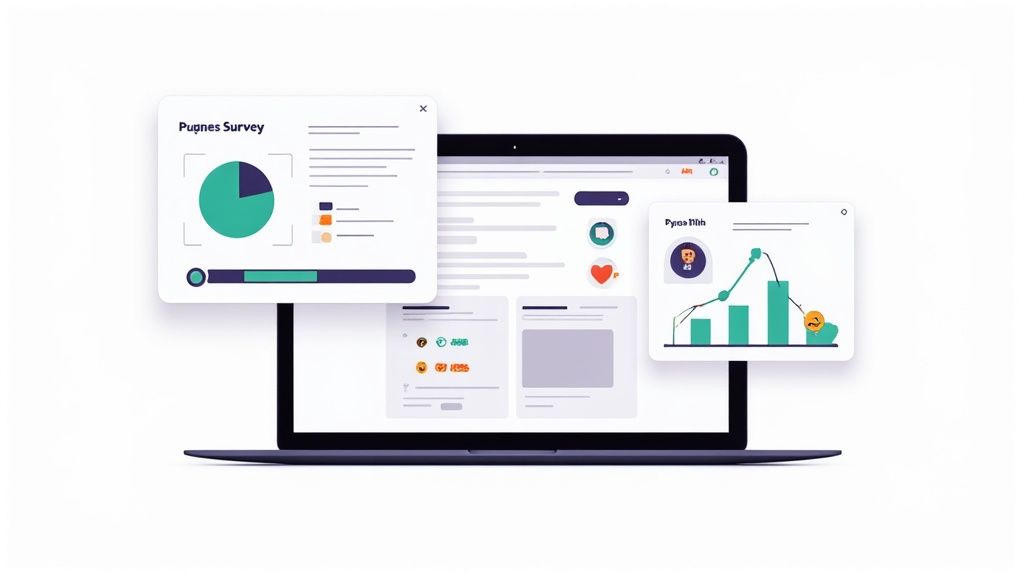
The dashboard instantly organizes the raw scores into those three crucial categories—Promoters, Passives, and Detractors. You can see the breakdown at a glance. If you want to dig even deeper, other tools can help you gain instant insights from your data directly within Slack by connecting your eNPS feedback to other business metrics.
Closing the Loop with Recognition and Action
Just collecting data is only half the job. A Slack-based eNPS program really starts to deliver value when you use the platform to act on the feedback you receive. This is where team recognition becomes your most powerful tool.
An eNPS program that isn't paired with visible action and recognition quickly loses credibility. When employees see their feedback translate into positive change and public appreciation, they become more invested in the process.
Let's walk through a practical, real-world scenario. Imagine your latest pulse survey shows the engineering team is feeling a bit burnt out and undervalued after a tough product launch. Here’s how you could tackle that, all within Slack:
-
Acknowledge the Feedback: The head of engineering posts in the main
#engineeringchannel: "Thanks to everyone who shared their thoughts in our recent eNPS check-in. We hear you, and we absolutely recognize the incredible effort that went into the V2 launch." -
Launch a Recognition Initiative: Using a tool like AsanteBot, you can quickly set up a peer-to-peer recognition system. Create a dedicated
#kudoschannel where anyone can give shout-outs or points to colleagues for their great work. -
Celebrate Publicly: The manager makes a point to highlight specific contributions. For example: "Major kudos to @jane for catching that critical bug under pressure. Her dedication saved us hours of rework and made the launch a success." This specific praise is far more impactful than a generic "good job."
-
Share the Impact: The next time an eNPS survey goes out, you can reference the new initiatives, closing the loop and showing everyone their voices truly matter.
This workflow doesn't just put out a fire; it builds a lasting culture where appreciation is a daily habit. By using one of the https://asantebot.com/blog/best-slack-apps/, you can bake recognition right into your company’s DNA. Suddenly, your eNPS isn't just a number—it’s a powerful catalyst for building a more supportive and motivated workplace.
Where eNPS Goes Wrong (And How to Get It Right)
Running an Employee Net Promoter Score program is about so much more than just sending out a survey. It’s about creating a genuine feedback loop built on trust. But even with the best intentions, a lot of companies stumble into common traps that can completely derail their efforts and, worse, damage employee morale.
Knowing what these pitfalls are is the first step. Avoiding them is how you turn a simple metric into a meaningful, ongoing conversation with your team.
Mistake #1: Asking for Feedback and Doing Nothing
This is the cardinal sin of employee engagement. You ask people to take time out of their day to share their thoughts, and then… crickets. When you repeatedly ask for opinions but never act on them, you’re sending a loud and clear message: "We don't actually care what you think."
This breeds cynicism faster than anything else. You're not just getting bad data; you're actively disengaging your team.
Here’s a practical example: A company runs quarterly eNPS surveys. For three quarters in a row, the team flags poor communication from leadership as a major problem. Leadership never acknowledges the feedback or communicates a plan. What happens? By the fourth survey, response rates have cratered by 50%, and the few comments you do get are dripping with sarcasm.
The Fix: Always, always close the loop. Share the high-level themes you heard—the good, the bad, and the ugly. Announce a simple action plan and, most importantly, follow up on it. Even small, visible changes prove you’re actually listening.
Mistake #2: Obsessing Over the Number
It’s tempting to fixate on the final score. We celebrate when it jumps from +15 to +20 and panic when it dips to +10. But the score itself is just a headline. The real story is in the comments—the why behind that number.
Focusing only on the score is like a doctor checking a patient’s fever but never asking about their symptoms. The number tells you something’s up, but the comments tell you what it is and how to start making it better.
Mistake #3: Jeopardizing Anonymity
Let's be honest: for an employee to give you brutally candid feedback, they need to feel safe. If there's even a hint that their comments can be traced back to them, they'll either soften their answers to avoid trouble or just won't bother responding at all.
Anonymity isn't a nice-to-have; it's the foundation of the entire process.
How to get it right:
- Use a Third-Party Tool: Platforms like AsanteBot are built to handle anonymous feedback, which immediately builds a layer of trust.
- Communicate the Guarantee: Tell your team—and then tell them again—that their individual responses are completely confidential and will only be looked at in aggregate.
- Don't Get Too Granular: Avoid slicing and dicing your data into tiny groups. If you're looking at "female engineers in the London office with less than one year of tenure," you're no longer anonymous, and people will figure that out quickly.
Mistake #4: Ignoring Your Promoters and What Makes Them Tick
Most companies immediately dive into what the Detractors are saying, which makes sense. You have to fix what's broken. But in the process, they completely forget to figure out what their Promoters love about working there. This is a huge missed opportunity, especially when it comes to understanding the power of team recognition.
Here's a practical example: A Promoter might give you a "10" because their manager is incredible at giving meaningful, specific praise. If you don't dig into that, you miss the chance to learn what that specific recognition looks like and train your other managers to do the same. By ignoring your biggest fans, you're missing out on the secret recipe for turning your neutral Passives into passionate Promoters—and that’s how you really move the needle on your score.
Got eNPS Questions? We've Got Answers
You're not alone if you have a few questions about making the Employee Net Promoter Score work for you. Let's tackle some of the most common ones that come up as teams start using this powerful metric.
How Often Should We Actually Send an eNPS Survey?
The right rhythm really depends on the pace of your company. Those old-school annual surveys? They're pretty much a relic. For most companies, a quarterly pulse survey hits the sweet spot.
This cadence is frequent enough to spot trends and see if your changes are actually making a difference, but it won't lead to survey fatigue. That said, if you're a startup in hyper-growth mode, you might even consider monthly check-ins during a period of intense change. The goal is to find a consistent schedule that gives you time to act on the feedback before asking for more.
Should We Really Worry About the "Passives"?
In a word: yes. The Passives—those who score you a 7 or 8—are often overlooked because they don't drag your score down. But that's a huge mistake. This group is a massive opportunity and, frankly, a big risk.
These are your employees who are just… fine. They're content enough, but they aren't emotionally invested. This makes them prime targets for recruiters. Think of them as a silent majority whose loyalty is totally up for grabs. The importance of team recognition is huge here; a practical example would be a manager publicly thanking a Passive employee for their consistent, high-quality work on a routine report. That small act could be all it takes to shift them into a full-blown Promoter. Ignoring them is like leaving a door wide open for your best talent to walk out.
Your real mission should be to convert Passives into Promoters. Dive into their feedback—it often points to the small, high-impact improvements that can make all the difference, like feeling more appreciated or seeing a clear future at the company.
How Is eNPS Different From a Big Engagement Survey?
The key difference is simplicity versus depth. An eNPS survey is like a quick snapshot of employee loyalty. It's built around one core question, making it incredibly easy to send out and perfect for tracking how sentiment is changing over time.
A full-blown employee engagement survey, on the other hand, is a deep dive. It's the MRI to the eNPS's thermometer, often with 50+ questions digging into everything from manager effectiveness to work-life balance and pay. Many of the smartest companies use both: they run a frequent eNPS pulse to keep a finger on the general mood and deploy a detailed engagement survey once a year to diagnose more complex, underlying issues.
Ready to turn feedback into a thriving culture of recognition? AsanteBot makes it easy to measure sentiment and celebrate wins right inside Slack. Start building a more engaged team today.