
10 Powerful Check In Questions for Meetings That Boost Team Morale in 2026
Dusan Milovanovic
Starting a meeting with a generic "How's everyone doing?" often gets you little more than a chorus of "good, thanks." But what if the first five minutes of your meeting could do more? What if they could surface hidden roadblocks, celebrate unsung heroes, and actively build the psychological safety that high-performing teams thrive on? This is the power of strategic check in questions for meetings. They transform a routine formality into a powerful ritual for connection, recognition, and alignment.
Table of Contents
- 1. Energy Level Check-In
- 2. Wins & Progress Check-In
- 3. Connection & Collaboration Check-In
- 4. Challenges & Support Check-In
- 5. Learning & Growth Check-In
- 6. Values & Culture Alignment Check-In
- 7. Gratitude & Appreciation Check-In
- 8. Wellbeing & Balance Check-In
- 9. Customer & User Impact Check-In
- 10. Feedback & Growth Mindset Check-In
- 10-Point Meeting Check-In Comparison
- Turn Your Check-Ins into a Recognition Engine
In this guide, we'll move beyond surface-level updates by exploring 10 distinct categories of purposeful check-in questions. We'll provide practical examples, explain the "why" behind each prompt, and show you how to integrate them into your workflow, which is especially useful for remote and hybrid teams. You will learn how these simple questions can become a cornerstone of a vibrant recognition culture, turning passive meetings into active moments of team-building.
By setting the right tone from the start, you ensure everyone is present and engaged. To ensure your team arrives prepared and on time for these valuable check-in sessions, consider utilizing effective meeting reminder email samples. This preparation allows the check-in to be a meaningful kick-off rather than a rushed formality.
1. Energy Level Check-In
The Energy Level Check-In is a simple yet powerful quantitative pulse check. It asks team members to rate their current energy, focus, or capacity on a numerical scale, typically 1 to 10. This approach quickly provides a snapshot of the team's overall well-being and readiness for the tasks ahead, making it one of the most efficient check-in questions for meetings.
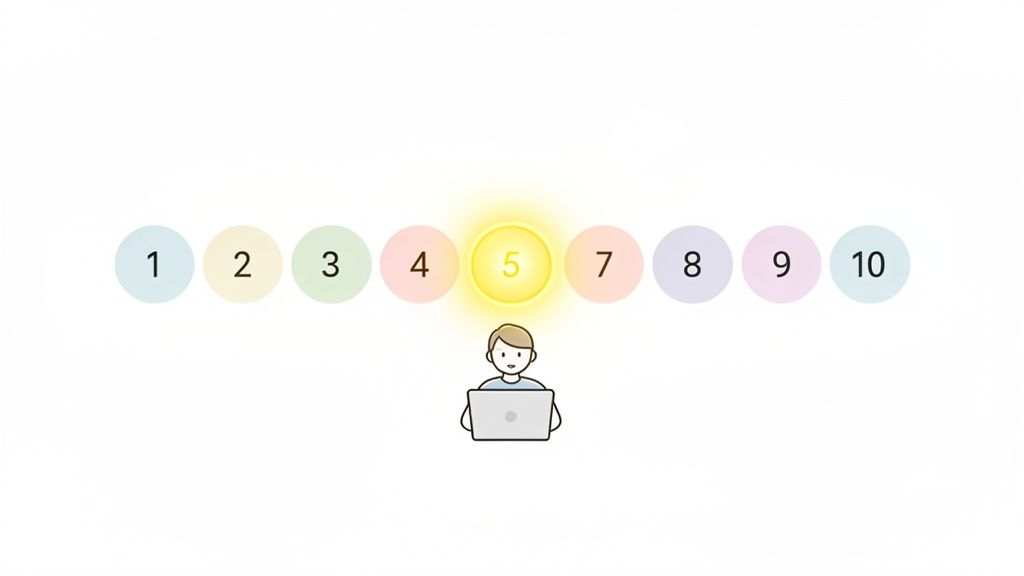
This method is particularly effective for remote or hybrid teams where visual cues about workload and stress are absent. It gives leaders a low-friction way to gauge morale without putting individuals on the spot. Recognizing and celebrating a team member who steps up to help a colleague with low energy is crucial for building a supportive culture where everyone feels valued.
How to Implement and Act on It
The key is to turn this data into action. A tech team, for instance, might use the results of a pre-sprint planning energy check to redistribute tasks.
-
Practical Example: Before a major project kickoff, the manager asks, "On a scale of 1-10, what's your capacity for new tasks this week?" If a key developer, Maria, reports a "3" while another, David, reports a "9," the manager can proactively say, "Thanks for sharing. David, could you take the initial setup task to give Maria some breathing room?" This prevents burnout and keeps the project on track.
-
Tip 1: Always pair the number with an optional, private comment field. This gives team members a confidential channel to add context if they choose.
-
Tip 2: Use an automated tool like AsanteBot to run these checks asynchronously in Slack. This allows you to track trends over time and identify patterns, such as energy dips at the end of a quarter.
-
Tip 3: Foster peer support. When you notice a team member consistently helping others who report low energy, use it as an opportunity for team recognition. A public shout-out like, "Big thanks to David for being flexible and supporting the team's balance," reinforces a supportive culture.
2. Wins & Progress Check-In
The Wins & Progress Check-In shifts the focus to positive momentum by asking team members to share a recent accomplishment or milestone. This prompt celebrates progress, reinforces a growth mindset, and creates natural opportunities for authentic peer recognition. It's one of the most effective check-in questions for meetings that aim to build a culture of appreciation and achievement.
This method is invaluable for distributed teams, where individual contributions can easily go unnoticed. By creating a dedicated space for sharing progress, leaders amplify small and large wins, making every team member feel seen and valued. This is the essence of team recognition: publicly acknowledging specific contributions to reinforce desired behaviors and boost morale. It directly counters the "out of sight, out of mind" challenge of remote work.
How to Implement and Act on It
The goal is to integrate celebration into your team's regular cadence. For example, a marketing team could kick off its weekly sync by sharing one campaign win, which immediately becomes a prompt for others to give kudos.
-
Practical Example: A product team uses this check-in to celebrate a developer who shipped a tricky feature. The manager starts the meeting by saying, "Let's start with a win. Alex, I know you pushed the new API integration live." Alex shares a brief success, and the manager follows up with, "That was a huge lift. Great work, Alex." This turns an individual success into a shared team victory.
-
Tip 1: Start meetings with this prompt to set a positive and forward-looking tone for the entire discussion.
-
Tip 2: Encourage the sharing of "small wins," like solving a difficult bug or receiving positive client feedback. This makes the practice accessible to everyone, regardless of their current project's stage.
-
Tip 3: Use the shared wins as direct catalysts for team recognition. When a colleague shares an achievement, encourage others to react with praise, reinforcing a supportive and appreciative environment.
3. Connection & Collaboration Check-In
This check-in moves beyond individual tasks to map the human network within your team. It asks team members to share who they have connected or collaborated with, or learned something from, since the last meeting. This question illuminates relationship patterns, surfaces hidden knowledge sharing, and reinforces the value of cross-functional teamwork, making it one of the most insightful check-in questions for meetings focused on culture.
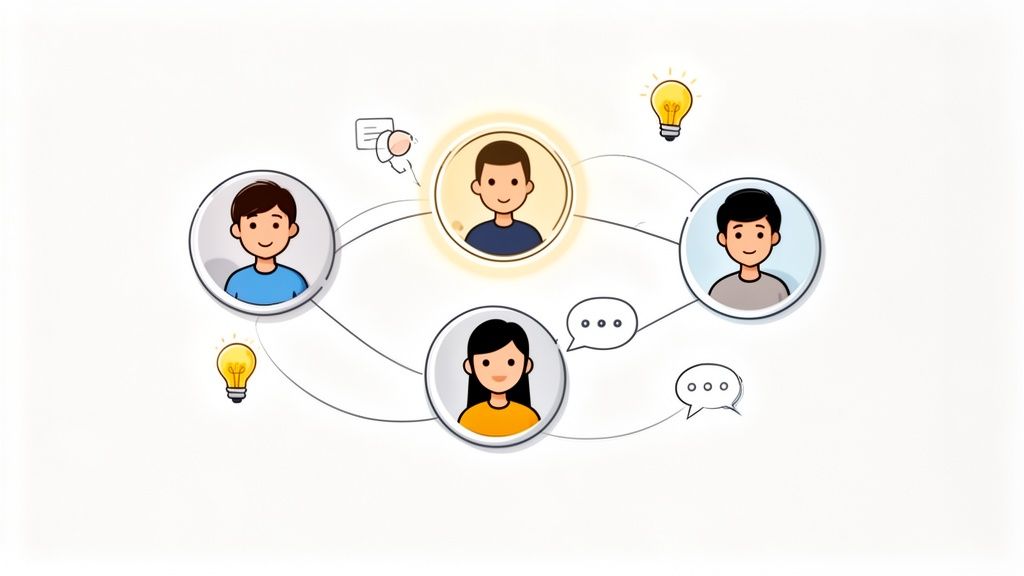
This method is especially valuable for remote or distributed teams where informal "water cooler" interactions are scarce. It provides visibility into the organic collaboration that drives innovation and helps identify natural mentors and connectors. Team recognition is critical here, as it highlights and rewards the often-invisible work of helping others, which strengthens the entire organization.
How to Implement and Act on It
The goal is to make these valuable connections visible and celebrate them.
-
Practical Example: A distributed startup asks, "Who did you learn something from this week?" A junior designer says, "I learned a new Figma shortcut from Lena on the engineering team." This insight allows leadership to formally recognize Lena's contribution, perhaps with a shout-out: "Kudos to Lena for helping colleagues across departments. This is what our value of 'Shared Knowledge' looks like in action!"
-
Tip 1: Frame the question to be specific and positive. Ask, "Who did you collaborate with this week, and what was one thing you learned from them?" This focuses on growth and mutual respect.
-
Tip 2: Use the responses to fuel team recognition. When you see someone frequently mentioned as a helpful collaborator, give them a public shout-out in a team-wide channel to reinforce that behavior.
-
Tip 3: Create a simple "collaboration leaderboard" or quarterly award for the team's "Top Connector." This gamified approach makes collaboration a visible and celebrated metric of success, just like project milestones.
4. Challenges & Support Check-In
The Challenges & Support Check-In moves beyond simple status updates to foster psychological safety. It invites team members to openly share current obstacles or areas where they need help. This type of check-in question for meetings normalizes vulnerability, surfaces blockers before they derail projects, and creates powerful opportunities for peer-to-peer support.
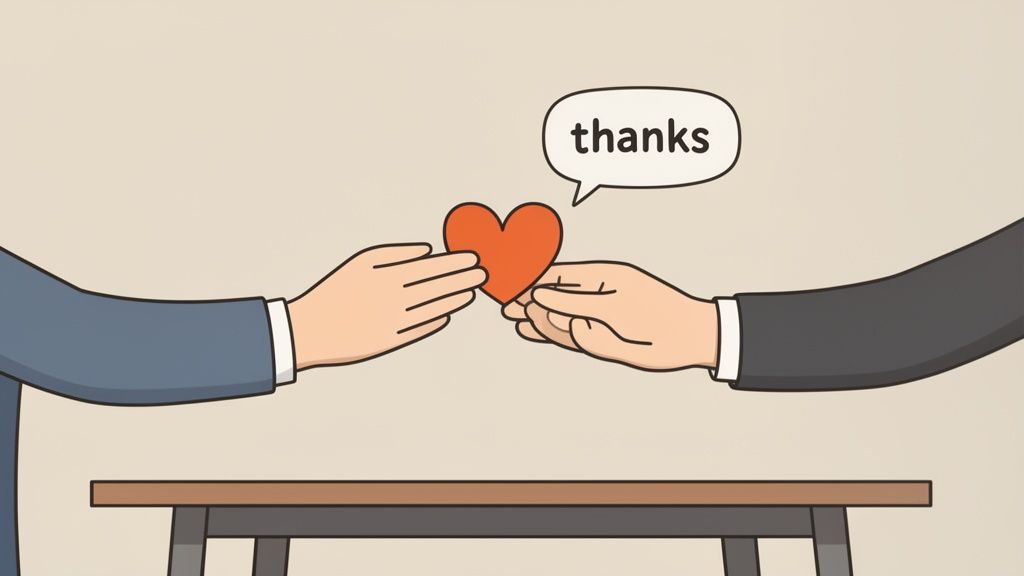
This approach is highly effective in engineering teams for identifying technical blockers early. When a team member helps another overcome a challenge, it's a perfect moment for team recognition. Celebrating this supportive behavior reinforces the idea that the team succeeds together and that helping others is a valued contribution. It demonstrates that the team succeeds or fails together, not as a collection of individuals.
How to Implement and Act on It
The goal is to connect needs with solutions.
-
Practical Example: During a daily stand-up, a junior marketer says, "I'm stuck on how to interpret the new analytics report." A senior team member, Chloe, immediately offers, "I have 15 minutes after this call to walk you through it." The manager can then close the loop with, "Thanks, Chloe. That's a great example of our team supporting each other." This provides both an immediate solution and positive reinforcement.
-
Tip 1: Always follow up privately with anyone who shares a significant or personal challenge. This shows genuine care beyond the scope of the meeting.
-
Tip 2: When a team member steps up to help another, make that an occasion for team recognition. Use a public channel to celebrate their supportive actions.
-
Tip 3: For leaders to provide the best support, they should be aware of resources for various needs, such as guidance for ADHD in the workplace, which can help create a more inclusive and effective environment.
5. Learning & Growth Check-In
The Learning & Growth Check-In shifts the focus from immediate tasks to long-term development. It prompts team members to share something new they've learned, are studying, or are curious about. This question fosters a culture of continuous improvement and signals that professional growth is a valued part of the team's identity.
This approach is highly effective for revealing hidden talents and emerging skill sets within the team. By asking "What's one new thing you learned this week?", leaders can uncover opportunities for peer-to-peer training. Recognizing those who share knowledge is vital; it encourages a learning culture where teaching and mentoring are seen as valuable contributions to the team's success.
How to Implement and Act on It
The goal is to connect individual curiosity with collective team growth.
-
Practical Example: In a weekly check-in, a customer support agent shares, "I've been learning Python scripting to automate some of my repetitive tasks." The manager can respond, "That's fantastic initiative! Would you be willing to do a quick 10-minute demo for the team next week?" This not only recognizes the agent's effort but also scales their learning to benefit everyone.
-
Tip 1: Frame the question broadly to include anything from a new software shortcut to a complex coding language. This makes it accessible to everyone, regardless of their role.
-
Tip 2: Use a dedicated Slack channel like
#learningsto create a searchable repository of shared knowledge. This becomes an internal resource for the whole company. -
Tip 3: Actively encourage peer support and mentorship. When one person's learning aligns with another's goals, make the connection. Use team recognition to highlight those who take the initiative to teach others, reinforcing a supportive and collaborative learning environment.
6. Values & Culture Alignment Check-In
The Values & Culture Alignment Check-In moves beyond simple status updates to reinforce what your organization stands for. This prompt asks team members to share a recent instance where they, or a colleague, embodied a core company value. This transforms abstract principles into tangible, celebrated behaviors, making it one of the most impactful check-in questions for meetings focused on culture.
This method is especially powerful for remote teams and scaling startups where maintaining a cohesive culture is challenging. It creates a continuous feedback loop that codifies your desired culture through real-world examples. This is the pinnacle of team recognition, as it directly links individual actions to the company's core identity, showing everyone what success looks like in your culture.
How to Implement and Act on It
The goal is to connect everyday actions to foundational principles.
-
Practical Example: A mission-driven nonprofit has a value of ‘Community First.’ The weekly check-in question is, "How did we live our 'Community First' value this week?" A team member shares, "Sam stayed late to help a partner organization meet a grant deadline, even though it wasn't our project." This not only provides powerful team recognition for Sam but also reinforces that specific behavior as a cultural benchmark.
-
Tip 1: Frame the question around a specific value. Instead of a general prompt, ask, "How did someone demonstrate our 'Bias for Action' value recently?" This focuses the responses and generates clearer examples.
-
Tip 2: Use an automation tool like AsanteBot to create recognition categories that directly match your core values. This allows you to tag shout-outs (e.g., #customer-obsession) and track which values are being recognized most often.
-
Tip 3: Amplify the stories. Collect the best examples shared during check-ins and highlight them in a company-wide newsletter or all-hands meeting to show everyone what living the values looks like in practice.
7. Gratitude & Appreciation Check-In
The Gratitude & Appreciation Check-In is a powerful exercise in team recognition that asks members to publicly acknowledge a colleague they are thankful for and why. This simple prompt actively normalizes peer-to-peer appreciation, making gratitude a visible and repeatable part of your team's weekly interactions. It is one of the most effective check-in questions for meetings focused on building a positive and supportive culture.
This method moves beyond generic team-building by creating specific, authentic moments of connection. For distributed teams, where spontaneous "thank yous" are rare, this structured check-in helps bridge the physical distance. This is the heart of team recognition—making appreciation a regular, visible habit that strengthens bonds and motivates everyone.
How to Implement and Act on It
The goal is to transform gratitude from an occasional gesture into a consistent team habit.
-
Practical Example: During a Friday wrap-up meeting, the manager asks, "Who would you like to appreciate this week and why?" One engineer says, "I'd like to thank Priya from marketing. Her detailed brief on the new feature saved me hours of guesswork." This specific, public acknowledgment makes Priya feel valued and encourages better cross-team collaboration in the future.
-
Tip 1: Frame the question directly: "Who would you like to appreciate this week and why?" The "why" is crucial as it provides specific context and makes the recognition more meaningful.
-
Tip 2: Amplify the moment in public channels. Use a tool like AsanteBot to follow up on verbal appreciation with a celebratory emoji reaction or a post in a #wins or #kudos channel in Slack, creating a lasting record.
-
Tip 3: Make it a weekly ritual. Designate a specific meeting, like a Friday wrap-up, as the dedicated time for appreciation. This consistency turns it into a cornerstone of your team recognition program.
8. Wellbeing & Balance Check-In
The Wellbeing & Balance Check-In moves beyond project status to ask about team members' lives outside of work. Questions like "What recharged you this week?" or "How is your work-life balance feeling?" create a space to acknowledge that employees are whole people, not just resources. This humanizing approach is one of the most vital check-in questions for meetings in remote environments where burnout risks are high and personal connection is scarce.
This method signals that the organization values sustainable performance and employee health. While less direct, it's a form of team recognition that honors the whole person. Recognizing and celebrating a teammate who actively supports a colleague's well-being—for instance, by encouraging them to take a break—reinforces a culture of care and mutual respect.
How to Implement and Act on It
The goal is to gather honest feedback and use it to make tangible improvements.
-
Practical Example: A startup noticed through these check-ins that several team members felt pressure to respond to messages after hours. One employee shared, "I felt overwhelmed until Mark reminded me it was okay to log off and that the email could wait until morning." In response, the leadership team implemented a "no-Slack after 6 PM" guideline and publicly recognized Mark for modeling healthy boundaries.
-
Tip 1: Frame questions openly, such as "What's one thing you did to disconnect recently?" This invites sharing without being intrusive.
-
Tip 2: Use an asynchronous tool to ask these questions privately. This ensures team members feel safe sharing honestly without public pressure.
-
Tip 3: Actively listen for opportunities for team recognition. When a colleague mentions that a teammate encouraged them to take a break or covered for them so they could attend a personal appointment, publicly acknowledge that supportive behavior. This reinforces the values you want to see and is a key strategy to improve team morale.
9. Customer & User Impact Check-In
The Customer & User Impact Check-In shifts focus from internal tasks to external value. This question asks team members to share a recent piece of customer feedback, a user win, or an example of how their work directly made a difference to the people they serve. This customer-centric prompt powerfully reconnects the team to its core mission.
This approach is especially valuable for engineering, operations, or support teams who may feel disconnected from the end-user. Recognizing the specific individuals or teams whose work led to positive customer outcomes is a powerful motivator. It validates their effort and reinforces the importance of quality and customer-centricity.
How to Implement and Act on It
The goal is to make customer impact a regular, celebrated part of the team's rhythm.
-
Practical Example: A SaaS product team starts its weekly meeting by asking, "What user feedback from this week should influence our next sprint?" A support specialist shares, "A customer sent a note saying the recent UI tweak by the design team saved them 'at least 10 clicks a day.'" The manager can then give direct team recognition: "Great job, design team! That's the kind of impact we strive for."
-
Tip 1: Frame the question specifically. Instead of a vague prompt, ask, "How did we positively impact a customer this week?" or "Share one piece of user feedback that stood out to you."
-
Tip 2: Use these moments for team recognition. When a developer shares how their bug fix prompted a glowing customer email, publicly acknowledge their contribution and the cross-functional effort that made it possible.
-
Tip 3: Create a dedicated Slack channel like
#customer-winswhere impact stories and positive feedback can be shared asynchronously. This creates an ongoing repository of motivation that the team can draw from anytime.
10. Feedback & Growth Mindset Check-In
This check-in transforms feedback from a dreaded event into a celebrated driver of growth. It prompts team members to share feedback they either received, gave, or acted on recently. This approach normalizes continuous improvement and builds the psychological safety necessary for high-performing teams, making it one of the most impactful check-in questions for meetings focused on development.
This method is particularly valuable for teams aiming to accelerate learning and innovation. The act of publicly appreciating constructive feedback is a powerful form of team recognition. It celebrates both the courage of the person giving the feedback and the growth mindset of the person receiving it, reinforcing that improvement is a team sport.
How to Implement and Act on It
The goal is to create a culture where feedback is a regular, positive touchpoint.
-
Practical Example: A design team starts its weekly critique with this check-in. One designer shares, “I received feedback from Sarah on the user flow for the new feature. Acting on it simplified the process, and I appreciate her clear, actionable advice.” The manager can then add, "Thank you for sharing that. And thank you, Sarah, for providing thoughtful feedback. That's how we all get better." This provides team recognition for both individuals.
-
Tip 1: Frame the question carefully. Use prompts like, "What's a piece of feedback you acted on this week, and what was the result?" or "Share a time you gave feedback that helped a teammate."
-
Tip 2: Always recognize both the giver and the receiver. This highlights the collaborative nature of growth and encourages more open dialogue. Learn more about how to cultivate better feedback from peers.
-
Tip 3: Ensure psychological safety is established first. This check-in works best in environments where trust is already high. If your team is new to this, start with a more general "What's something you learned this week?" and gradually introduce the feedback element.
10-Point Meeting Check-In Comparison
| Check-In Type | 🔄 Implementation Complexity | ⚡ Resource Requirements | 📊 Expected Outcomes | Ideal Use Cases | ⭐ Key Advantages & 💡 Tips |
|---|---|---|---|---|---|
| Energy Level Check-In | Low — single 1–10 question | Minimal — quick prompts, analytics hook | Rapid morale signal; early burnout detection | Remote teams, daily standups, sprint planning | ⭐ Measurable wellness baseline; 💡 Pair with optional comment, track weekly trends |
| Wins & Progress Check-In | Low — simple prompt and archive | Low — channel + emoji recognition integration | Boosts engagement; creates shareable recognition moments | Marketing, product teams, distributed groups | ⭐ Fuels peer recognition; 💡 Start meetings with wins, archive for momentum |
| Connection & Collaboration Check-In | Medium — requires mapping and regular tracking | Medium — tracking tools, analytics for networks | Reveals collaboration patterns and connectors | Startups, cross-functional teams, distributed orgs | ⭐ Identifies internal mentors/connectors; 💡 Ask who you learned from, build leaderboards |
| Challenges & Support Check-In | Medium — needs follow-up workflows | Medium — leader time, escalation/ support resources | Surfaces blockers early; enables peer support | Engineering, remote teams, HR-led wellbeing efforts | ⭐ Encourages supportive recognition; 💡 Follow up privately, publicly celebrate helpers |
| Learning & Growth Check-In | Low–Medium — recurring prompt with sharing channels | Low — sharing channels, optional training resources | Increases skill visibility; uncovers upskilling needs | Tech teams, cross-functional learning groups, startups | ⭐ Promotes retention through development; 💡 Ask weekly, create topic channels |
| Values & Culture Alignment Check-In | Medium — requires clear values and examples | Low–Medium — communication, leadership modeling | Makes values tangible; reinforces culture | Scaling companies, mission-driven orgs | ⭐ Aligns behavior to mission; 💡 Tie question to specific core values |
| Gratitude & Appreciation Check-In | Low — direct appreciation prompt | Minimal — ritual + emoji recognition tool | Immediate recognition; strengthens belonging | Distributed teams, small companies, daily standups | ⭐ Builds recognition habit quickly; 💡 Make it a weekly ritual and use emoji shout-outs |
| Wellbeing & Balance Check-In | Medium — privacy-sensitive handling needed | Medium — HR oversight, confidential channels | Early burnout warning; promotes boundary-setting | Remote-first companies, HR monitoring, startups | ⭐ Signals genuine care for people; 💡 Keep responses confidential and act on signals |
| Customer & User Impact Check-In | Low–Medium — needs access to feedback data | Medium — customer feedback channels, comms | Strengthens purpose alignment; surfaces impact stories | SaaS, product teams, nonprofits removed from end-users | ⭐ Makes work outcomes tangible; 💡 Share customer anecdotes regularly |
| Feedback & Growth Mindset Check-In | High — requires strong psychological safety | Medium — training, leader modeling, safe forums | Normalizes feedback; accelerates learning and trust | High-performing teams, leadership groups, design/engineering | ⭐ Rewards growth behaviors; 💡 Ensure safety first, recognize both giver and receiver |
Turn Your Check-Ins into a Recognition Engine
The journey through our extensive list of check in questions for meetings reveals a powerful truth: the first five minutes of any gathering can redefine its entire trajectory. We've moved far beyond the generic "How is everyone doing?" to explore specific, purposeful prompts designed to gauge energy, celebrate progress, and uncover hidden challenges. By now, you've seen how a simple, well-chosen question can transform a routine status update into a dynamic forum for connection, learning, and mutual support.
The real magic happens when you see these questions not just as a way to start a meeting, but as a system for continuously surfacing the positive behaviors that drive your team forward. A "Wins & Progress" check-in isn't just a report; it's a chance to see who is excelling. A "Challenges & Support" prompt doesn't just identify roadblocks; it highlights who is stepping up to help their colleagues. These moments are the raw material of a thriving culture, but they are often fleeting and forgotten as soon as the meeting ends.
From Fleeting Moments to Lasting Recognition
The crucial next step is to capture this positive momentum. A spoken "great job" is valuable, but making that recognition visible, trackable, and celebrated by the wider team amplifies its impact exponentially. When an employee mentions how a coworker helped them overcome a blocker, you have a perfect opportunity to model a culture of appreciation.
This transforms your check-in from a simple ritual into a powerful recognition engine. It creates a positive feedback loop:
- Purposeful Questions: You ask questions that surface specific, positive behaviors.
- Valuable Answers: Team members share stories of collaboration, support, and achievement.
- Visible Recognition: You immediately acknowledge these actions, reinforcing their importance.
- Cultural Reinforcement: The team sees what is valued and is encouraged to repeat those behaviors.
This approach ensures that recognition isn't a top-down, once-a-quarter event. It becomes a daily, peer-driven habit woven directly into your team's operational rhythm. By mastering the art of asking better check in questions for meetings, you are simultaneously building a more transparent, engaged, and high-performing team where everyone feels seen and valued for their contributions. Your next meeting is the perfect place to start. Choose one question from this guide, listen intently to the answers, and be ready to celebrate the excellence you uncover.
Ready to turn those check-in insights into a powerful, visible recognition system? AsanteBot integrates directly into your Slack workspace, allowing your team to instantly celebrate wins and appreciate each other with a simple emoji reaction. Start building a culture of continuous appreciation today by exploring AsanteBot.
About the author

Keep reading
More from the blog
 company culture
Unlocking Motivation with Non Monetary Incentives
In a world where top talent can work from anywhere, non-monetary incentives have become the strategic advantage that sets great companies apart.
 Tips & Tricks
Giphy for Slack: Setup, Commands & Troubleshooting
Use the Giphy app in Slack, check command availability, and manage GIF settings. Learn how the app differs from Slack’s built-in GIF picker.
 employee recognition
How to Boost Team Morale and Drive Real Performance
Low team morale isn't just a mood issue; it’s a real business problem. To fix it, you have to dig into the root causes—things like a lack of recognition or psychological safety—and build consistent habits that show your people they're genuinely valued.