
8 Powerful Peer Feedback Examples to Elevate Your Team in 2026
Dusan Milovanovic
In today's fast-paced, often-remote work environment, the simple act of acknowledging a colleague's contribution can be the difference between a disconnected group and a high-performing team. Yet, generic praise like 'good job' or 'thanks' often misses the mark, failing to reinforce the specific behaviors that drive success. This is where the power of structured, thoughtful peer feedback comes in. It’s not just about being nice; it’s a strategic tool for building psychological safety, clarifying expectations, and fostering a culture of continuous improvement.
Table of Contents
- 1. Specific Behavior Recognition (SBR)
- 2. Behavioral Impact Feedback
- 3. Growth-Oriented Peer Feedback (GOPF)
- 4. 360-Degree Peer Feedback Synthesis
- 5. Real-Time Behavioral Coaching Feedback
- 6. Strength-Based Peer Recognition (SBPR)
- 7. Cross-Functional Peer Feedback Loops
- 8. Values-Aligned Behavior Feedback
- 8-Point Peer Feedback Comparison
- Making Recognition a Habit, Not a Task
The importance of team recognition cannot be overstated; it's the engine of engagement and retention. When employees feel seen and valued for their specific contributions, they are more motivated, collaborative, and aligned with company goals. Moving beyond vague compliments to deliver detailed, actionable praise creates a positive reinforcement loop that elevates the entire organization's performance. For a broader understanding of various feedback approaches and their practical application, you may find this complete guide to employee feedback examples and tips useful.
This guide provides a comprehensive list of actionable peer feedback examples designed to help you and your team communicate with impact. We will explore distinct models for giving feedback that is specific, impactful, and growth-oriented. You will learn how to transform simple shout-outs into powerful moments of connection and development, especially when integrated into daily workflows like Slack with tools such as AsanteBot. We'll break down templates for everything from recognizing specific behaviors and highlighting their impact to delivering growth-oriented suggestions and celebrating cross-functional wins.
1. Specific Behavior Recognition (SBR)
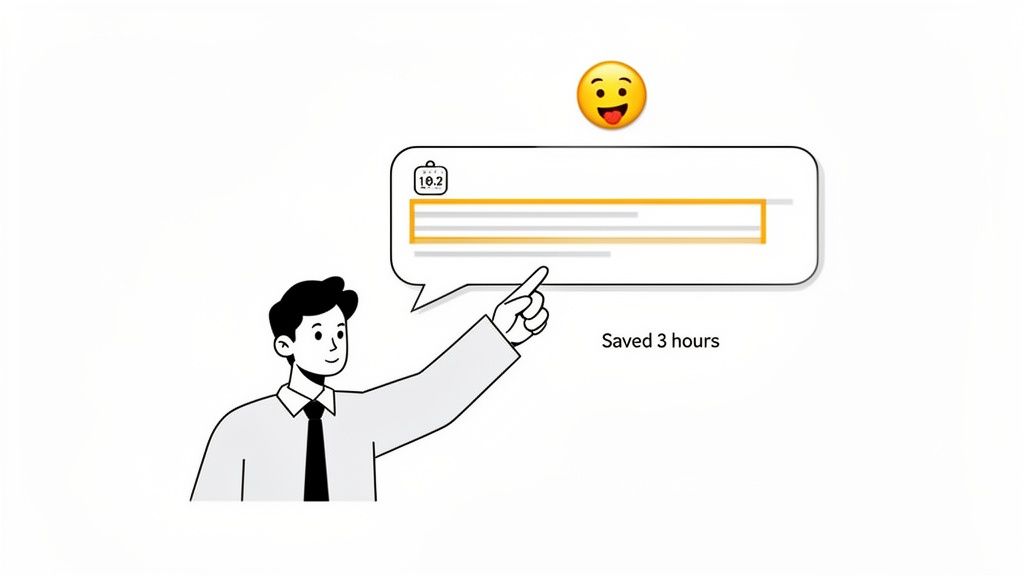
Specific Behavior Recognition (SBR) is a feedback method that moves beyond generic praise to acknowledge concrete, observable actions. Instead of saying "Great job," SBR focuses on what a person did, how they did it, and the specific impact it had. This technique makes feedback more meaningful and actionable, showing team members exactly which behaviors are valued and should be repeated.
This approach is powerful because it connects individual actions directly to team and company outcomes, reinforcing a culture of purpose and high performance. It's one of the most effective peer feedback examples because it eliminates ambiguity and provides a clear model for others to follow. Team recognition built on SBR boosts morale by showing that every specific, positive action is seen and valued.
How It Works: The SBR Formula
The core of SBR is a simple, three-part structure: Action + Context + Impact.
- Action: What specific task did the person complete? Be precise.
- Context: When or where did this happen? Reference a project, meeting, or specific situation.
- Impact: What was the positive result? Quantify it with data or describe the qualitative benefit.
Practical Examples:
- Example 1: "During yesterday's sprint planning (Context), you created a detailed bug report for the authentication module (Action). That saved the engineering team at least three hours of debugging (Impact)."
- Example 2: "Thank you for proactively creating the project documentation in Confluence yesterday (Action). It helped me get up to speed on the Q3 goals in under 20 minutes (Impact)."
This detailed feedback is far more motivating and provides a clear blueprint for what excellence looks like within the team.
Actionable Tips for Implementation
- Link to Company Values: Connect the specific behavior to a core company value. For instance, "Your willingness to jump in and help QA the new feature perfectly demonstrates our 'All Hands on Deck' value."
- Use Quantifiable Metrics: Whenever possible, include numbers. Mentioning that a data visualization made results "40% clearer" is more powerful than saying it was "helpful."
- Integrate with Tools like AsanteBot: Configure AsanteBot with custom emojis that represent specific valued behaviors (e.g., 🐛 for problem-solving, 🎓 for mentoring). This creates a shared language for recognition directly within Slack, making SBR a seamless part of daily workflow.
- Practice in Team Meetings: Dedicate two minutes at the start of a team meeting for peers to share SBR-style recognition. This builds the habit and makes it a public part of your team's culture.
2. Behavioral Impact Feedback
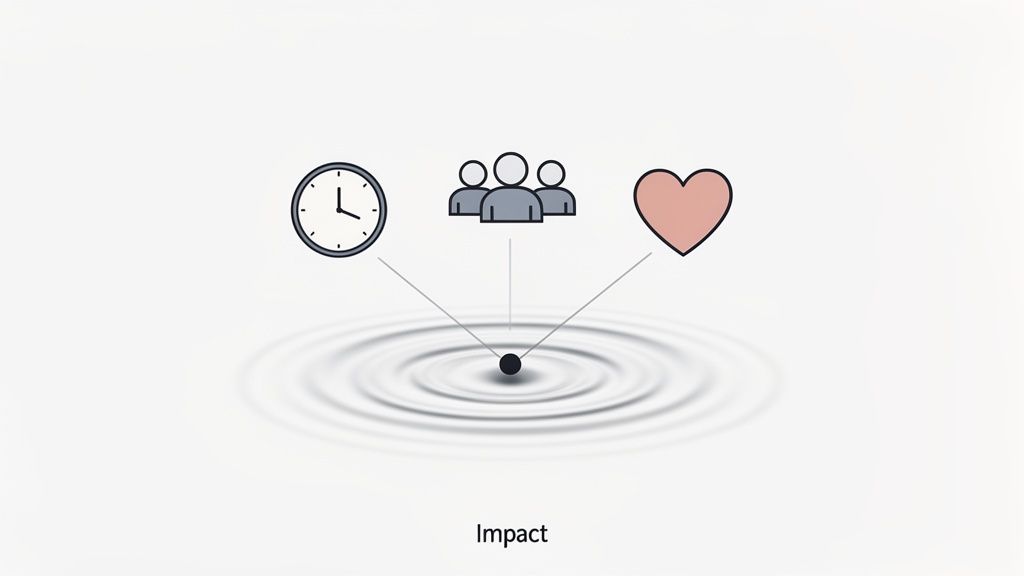
Behavioral Impact Feedback connects a peer's actions to their observable consequences on team members, projects, or the organization. Instead of just stating what someone did, it focuses on explaining how their behavior affected others' work, morale, or outcomes. This approach creates a powerful feedback loop where employees understand their ripple effect, fostering intrinsic motivation and a deeper team connection.
This method is one of the most effective peer feedback examples because it highlights interdependence and reinforces the idea that every contribution matters. The importance of this type of team recognition lies in its ability to build empathy and show that even small, supportive actions have a significant positive effect on the team's success and well-being.
How It Works: The Behavior + Consequence Formula
The core of this method is a clear, cause-and-effect structure: Observed Behavior + Specific Consequence.
- Observed Behavior: What did the person do? Describe the action or pattern of behavior.
- Specific Consequence: What was the direct result of that behavior on you, the team, or a customer?
Practical Examples:
- Example 1: "Because you answered my questions patiently in Slack yesterday (Observed Behavior), I unblocked myself and managed to ship my feature before the deadline (Specific Consequence)."
- Example 2: "When you took the time to explain the new API to me (Observed Behavior), it gave me the confidence to start building my integration without any delays (Specific Consequence)."
This detailed feedback provides a clear narrative of cause and effect, which is far more meaningful and helps build a culture of mutual support.
Actionable Tips for Implementation
- Frame Impact in Terms Peers Value: Connect the behavior to outcomes your colleagues care about, such as reducing repetitive work, improving customer satisfaction, or enhancing psychological safety.
- Celebrate Non-Obvious Roles: Use this feedback to recognize the crucial work of coordinators, communicators, and culture-builders whose contributions aren't always tied to direct output. Example: "Your transparent update about project delays helped us manage client expectations and saved the account relationship."
- Use Analytics to Find Connectors: Configure AsanteBot analytics to identify "connectors" – individuals whose supportive behaviors have a disproportionate impact relative to their job title. This uncovers hidden leaders and reinforces positive team dynamics.
- Prompt for Impact: In scheduled feedback moments or AsanteBot prompts, ask specifically: "How did a teammate's action positively affect your work this week?" This trains the team to think in terms of consequence.
3. Growth-Oriented Peer Feedback (GOPF)
Growth-Oriented Peer Feedback (GOPF) is a forward-looking approach that emphasizes a colleague's development potential and learning opportunities over past performance alone. Instead of just reviewing what was done, GOPF focuses on what could be. Peers highlight observed strengths and connect them to future roles, skill-building opportunities, or leadership potential. This model shifts the conversation from evaluation to empowerment, creating psychological safety around continuous improvement.
This method is powerful because it directly supports career progression conversations and fosters a culture where team members are invested in each other's growth. The importance of this form of team recognition is that it shows colleagues their potential is seen and valued, motivating them to invest in their own development and stay with the company long-term. For feedback to truly facilitate development, it's essential for individuals to approach it with a growth-oriented perspective, understanding the core differences between a fixed and growth mindset.
How It Works: The GOPF Formula
The core of GOPF follows a three-part structure: Observation + Potential + Connection.
- Observation: What specific skill or strength did you observe? Be concrete.
- Potential: What future role or advanced capability does this skill point to?
- Connection: How does this potential link to a specific opportunity or next step?
Practical Examples:
- Example 1: "The way you handled that tense client negotiation last week showed real emotional intelligence and strategic thinking (Observation). You would be great in a senior customer success or people leadership role (Potential). You should explore the management training program we offer (Connection)."
- Example 2: "I was so impressed by how you structured the database for our last project (Observation). Your skills in data architecture are becoming really advanced, and you'd be a natural fit to lead the technical design for our next big initiative (Potential & Connection)."
This detailed, forward-looking feedback provides a clear and inspiring pathway for professional development, showing team members that their growth is seen and supported.
Actionable Tips for Implementation
- Pair with Concrete Next Steps: Always link growth feedback to a tangible action. Suggest a training program, an internal mentorship opportunity, or a specific project that would build on the observed strength.
- Ensure Manager Follow-Up: Growth feedback is most effective when managers are looped in. Create a process where managers follow up on GOPF within 30 days to discuss creating a formal development plan.
- Use AsanteBot to Identify Momentum: Track recognition trends with AsanteBot's analytics. Team members who consistently receive growth-oriented praise may be ready for expanded roles or leadership opportunities.
- Create a Dedicated Slack Channel: Establish a
#career-growthchannel where GOPF can be shared openly. This encourages transparent conversations about development and allows others to offer support and resources. Learn more about how to leverage feedback from peers for career development.
4. 360-Degree Peer Feedback Synthesis
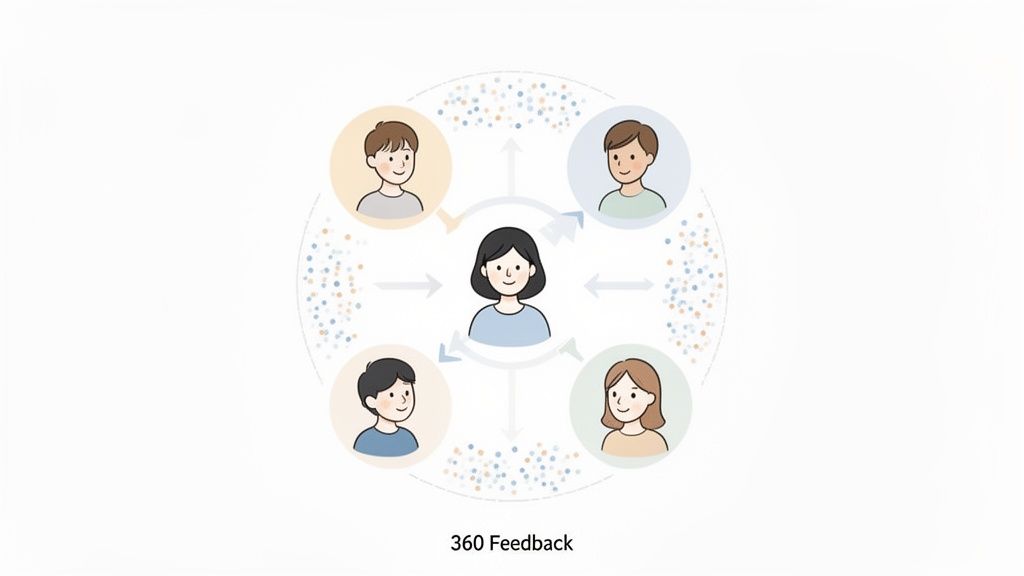
360-Degree Peer Feedback Synthesis aggregates input from multiple perspectives, including peers, managers, and direct reports, to create a holistic view of an individual's performance and behavior. Instead of relying on a single source, this approach gathers diverse feedback to identify consistent patterns, uncover blind spots, and validate strengths. This comprehensive model transforms team recognition from a one-on-one exchange into a community-driven development tool.
This method is powerful because it provides a balanced and well-rounded picture, moving beyond individual biases. By synthesizing various viewpoints, it highlights how a person's actions are perceived across different relationships within the organization, making it one of the most insightful peer feedback examples for deep, personal development.
How It Works: The Synthesis Formula
The core of this method is Collect + Synthesize + Action. It's a cyclical process designed for continuous growth.
- Collect: Gather feedback from multiple sources on specific competencies or behaviors.
- Synthesize: Analyze the collected data to identify recurring themes, patterns, and contradictions.
- Action: Create a targeted development plan based on the synthesized insights.
Practical Example:
- Single-Source Feedback: A peer says, "You are very collaborative in our team meetings." (Helpful but incomplete)
- 360-Degree Synthesis:
- Peers: Note that you are highly collaborative and bring great ideas.
- Manager: Observes that while your ideas are strong, you sometimes dominate the conversation.
- Direct Report: Mentions they feel hesitant to speak up after you've shared your thoughts.
- Insight: The synthesis reveals a clear developmental opportunity: learn to facilitate discussion and create space for others, a blind spot that single-source feedback would have missed.
This multi-faceted approach provides the rich context needed to drive meaningful behavioral change and validates the importance of team recognition as a source of truth.
Actionable Tips for Implementation
- Ensure Anonymity and Safety: Clearly communicate that feedback is for development, not evaluation. Aggregate at least 4-5 feedback sources before sharing insights to protect confidentiality and encourage honesty.
- Focus on Specific Competencies: Instead of asking broad questions, run lightweight monthly "pulse" 360s with 3-4 questions targeted at a specific skill, like communication or project management.
- Use AsanteBot for Continuous Collection: Configure AsanteBot to collect feedback tied to specific projects or interactions. Use custom tags like
#communicationor#leadershipto easily categorize and later synthesize insights directly within Slack. - Pair Synthesis with Mentorship: Create a private Slack channel where an individual can review their synthesized feedback report with a trusted manager or mentor. This provides a supportive environment to process the information and create an action plan.
5. Real-Time Behavioral Coaching Feedback
Real-Time Behavioral Coaching Feedback delivers immediate, specific guidance in the moment or shortly after a behavior occurs. Instead of waiting for formal reviews, peers offer constructive input designed to support on-the-spot learning and skill development. This method creates tight feedback loops that accelerate growth and foster a culture of continuous improvement.
This approach is powerful because it addresses behaviors while the context is fresh, making the advice more relevant and easier to absorb. As one of the most supportive peer feedback examples, it demonstrates a genuine investment in a colleague's professional development, strengthening team bonds and psychological safety. This type of recognition, focused on improvement, shows that team members care about each other’s success, which is a vital component of a healthy culture.
How It Works: The Coaching Formula
The core of this method is a supportive, four-part structure: Observation + Impact + Suggestion + Support.
- Observation: State a specific, neutral observation of a behavior.
- Impact: Explain the consequence or potential effect of that behavior.
- Suggestion: Offer a concrete, alternative action for the future.
- Support: Reaffirm confidence and offer help, showing you are an ally.
Practical Examples:
- Example 1: "In the client call (Observation), I noticed you didn't share your data insights. Since you have the deepest knowledge, the client missed a key piece of information (Impact). Next time, maybe you could prepare one key slide to present? (Suggestion). I'm happy to review it with you beforehand (Support)."
- Example 2: "I saw that you jumped straight to solutions in the brainstorming meeting (Observation), which might have cut the creative process a bit short (Impact). Maybe next time we could try dedicating the first ten minutes to 'blue-sky' ideas only? (Suggestion). I can help keep time if you'd like (Support)."
This detailed coaching is encouraging, not critical, and provides a clear, actionable path forward.
Actionable Tips for Implementation
- Ask for Permission: Always start by asking if the person is open to feedback. A simple, "Hey, are you open to some quick feedback on the presentation?" respects their autonomy and makes them more receptive.
- Keep it Private: Use direct messages for constructive coaching to maintain psychological safety. Public channels are for praise; private channels are for growth. This prevents embarrassment and fosters trust.
- Use a Template in Slack: Create a saved Slack message or workflow for coaching. A template like: "Observation: [What I saw/heard], Impact: [The result], Suggestion: [An idea for next time], How can I help?: [Offer of support]" ensures consistency and care.
- Follow Up: Check in a week or two later. A message like, "I saw you lead with the business impact in the thread today-it really landed well with the marketing team! Great work," reinforces the positive change and shows you are paying attention.
6. Strength-Based Peer Recognition (SBPR)
Strength-Based Peer Recognition (SBPR) shifts the focus of feedback from correcting weaknesses to identifying and amplifying a person's natural talents. Instead of generic praise, SBPR encourages colleagues to pinpoint specific strengths, such as strategic thinking or relationship-building, and connect them to real-world contributions. This approach, rooted in frameworks like Clifton StrengthsFinder, makes individuals feel seen for their unique abilities, boosting both confidence and engagement.
This method is one of the most powerful peer feedback examples because it fosters a culture where team members are valued for who they are, not just what they do. By consciously recognizing innate talents, teams can more effectively delegate tasks, assign roles, and build a more resilient and energized workforce. The importance of this type of team recognition is its direct link to employee engagement; people are most effective when they can use their natural strengths.
How It Works: The SBPR Formula
The core of SBPR follows a simple structure: Strength + Evidence + Potential.
- Strength: Name the specific talent or character strength you observed.
- Evidence: Provide a concrete example of when they used this strength.
- Potential: Suggest how this strength could be further leveraged for growth or impact.
Practical Examples:
- Example 1: "Your strategic thinking and comfort with ambiguity (Strength) really shone when you mapped out the initial plan for our new product exploration (Evidence). Have you considered taking the lead on the next discovery phase? Your talents would be a huge asset there (Potential)."
- Example 2: "Your strength in empathy (Strength) was so clear when you de-escalated that customer complaint on Tuesday (Evidence). That skill would be invaluable for mentoring our new support hires (Potential)."
This detailed feedback not only validates a colleague's skills but also actively helps them chart their career path within the company.
Actionable Tips for Implementation
- Create a 'Strengths Spotlight': Dedicate a monthly segment in your team's Slack channel to celebrate how different individuals have used their unique strengths. This makes the practice visible and habitual.
- Pair Strengths with Opportunities: Don't just praise a strength; connect it to a future project. For example, "Given your analytical rigor, would you be interested in leading our upcoming data audit project?"
- Integrate with AsanteBot: Customize AsanteBot emoji reactions to align with key strength categories (e.g., 💡 for innovative thinking, 🤝 for relationship-building, 🧭 for strategic direction). This makes giving strength-based feedback as easy as adding a reaction.
- Track Recognized Strengths: Use your recognition tool's analytics to see which strengths are celebrated most and which are overlooked. This can reveal if certain valuable talents, like empathy or creativity, are being undervalued in your culture. Explore more peer to peer recognition examples to diversify your approach and learn more about Strength-Based Peer Recognition (SBPR) on asantebot.com.
7. Cross-Functional Peer Feedback Loops
Cross-Functional Peer Feedback Loops create a deliberate structure for feedback between people in different teams or departments who rely on each other. Instead of feedback remaining siloed within a single team, this approach illuminates how one group's work impacts another. It is designed to break down organizational silos, build empathy, and identify crucial opportunities for better collaboration.
This method is especially powerful in matrix organizations or companies where project success depends on seamless handoffs. By formalizing these communication channels, it transforms potential friction points into sources of constructive dialogue and shared improvement. It's one of the most strategic peer feedback examples for improving overall organizational efficiency, as team recognition between departments reinforces a "one team" mentality.
How It Works: The Dependency-Driven Formula
The core of this method is to connect feedback directly to inter-team dependencies, following a simple formula: Observation + Impact on My Team + Suggestion/Question.
- Observation: State a specific action or output from the other team.
- Impact on My Team: Clearly explain how that action helped or hindered your team’s workflow.
- Suggestion/Question: Propose a collaborative solution or ask a question to foster dialogue.
Practical Examples:
- Positive: "The brand guidelines you shared last week were very detailed (Observation). This clarity has helped our team create on-brand designs 50% faster, reducing rework (Impact on My Team). For future campaigns, could we define a 'rapid-response' asset kit to help us move even quicker? (Suggestion)."
- Constructive: "The latest API update didn't include release notes (Observation), which caused our front-end team to spend half a day debugging the integration (Impact on My Team). Could we work together to create a simple release note template for future updates? (Question)."
This approach reframes feedback as a shared problem-solving exercise rather than a complaint, encouraging positive and productive outcomes.
Actionable Tips for Implementation
- Map Your Dependencies: Before asking for feedback, visually map out which teams your team depends on and which teams depend on you. This creates a clear guide for who should be giving and receiving feedback.
- Schedule Cross-Functional Feedback Days: Use a tool like AsanteBot to schedule a recurring monthly or quarterly event where automated prompts are sent to interdependent teams, asking for specific feedback on recent collaborations.
- Create Dedicated Channels: Establish shared Slack channels for key partnerships (e.g.,
#eng-product-feedback,#support-eng-escalations). This provides a persistent space for ongoing dialogue and makes feedback a continuous process. - Celebrate Collaborative Wins: When you see a great example of cross-functional work, celebrate it publicly. Use AsanteBot to give recognition that tags members from all involved teams, reinforcing the value of strong partnerships. For instance, "Kudos to @anna (Marketing) and @david (Product) for the seamless feature launch!"
8. Values-Aligned Behavior Feedback
Values-Aligned Behavior Feedback connects a peer's actions directly to core company principles. Instead of just praising good work, this method explicitly names how a specific behavior exemplified a stated organizational value, such as "Customer Obsession" or "Radical Transparency." This approach transforms abstract cultural tenets into tangible, observable actions that reinforce your company's identity.
This type of feedback is crucial for building and sustaining an intentional culture. It serves as a real-time reinforcement mechanism, showing everyone what your values look like in practice. By highlighting these moments, you create powerful peer feedback examples that guide behavior and decision-making across the entire organization. The importance of this form of team recognition is that it makes the company culture tangible and owned by everyone.
How It Works: The Value-Action-Impact Formula
The framework for this feedback is straightforward: Value + Specific Action + Impact.
- Value: Name the specific company value being demonstrated.
- Specific Action: Describe the concrete behavior you observed.
- Impact: Explain the positive outcome this action had on the team, a customer, or the business.
Practical Examples:
- Example 1: "You spent an extra hour on that support call to help a customer troubleshoot a rare bug (Specific Action). That's a perfect example of our 'Customer Obsession' value (Value), and it turned a frustrated user into a loyal advocate (Impact)."
- Example 2: "When you flagged that security concern in the all-hands meeting even though it was uncomfortable (Specific Action), you truly lived our 'Radical Transparency' value (Value). It prompted a crucial discussion that made our product safer (Impact)."
This detailed feedback does more than just recognize an individual; it celebrates and reinforces a core piece of your company's DNA, making culture a shared responsibility.
Actionable Tips for Implementation
- Map Values to Emojis: In AsanteBot, create a custom emoji for each company value (e.g., 🎯 for 'Customer Obsession,' 💡 for 'Continuous Learning'). This creates a visual, easy-to-use shorthand for giving values-based recognition directly in Slack.
- Focus Weekly Prompts: Dedicate weekly AsanteBot prompts to a specific value. Ask, "Who demonstrated our 'Bias for Action' value this week?" This keeps all values top-of-mind and encourages peers to look for relevant examples.
- Create a 'Values in Action' Channel: Make a public Slack channel where the best peer feedback examples are shared. When someone gives great values-aligned feedback, screenshot it and post it there to create a living library of what your culture looks like.
- Analyze Recognition Patterns: Use reporting tools to see which company values are frequently recognized and which are not. An underrecognized value might indicate a culture gap or a principle that needs clearer definition and reinforcement from leadership.
8-Point Peer Feedback Comparison
| Approach | Implementation Complexity 🔄 | Resource Requirements ⚡ | Expected Outcomes 📊⭐ | Ideal Use Cases 💡 | Key Advantages ⭐ |
|---|---|---|---|---|---|
| Specific Behavior Recognition (SBR) | 🔄🔄 — Requires concise, timely phrasing | ⚡⚡ — Low time per note; needs consistency | 📊 Clear behavior-to-outcome links; ⭐⭐⭐ | Distributed teams, startups needing accountability | Creates measurable standards; useful for reviews; reduces ambiguity |
| Behavioral Impact Feedback | 🔄🔄 — Needs understanding of ripple effects | ⚡⚡ — Moderate: context gathering/analytics | 📊 Increases empathy & motivation; ⭐⭐⭐ | Cross-functional/remote teams where impact is unseen | Makes invisible work visible; drives intrinsic motivation |
| Growth-Oriented Peer Feedback (GOPF) | 🔄🔄 — Balance praise with future-looking guidance | ⚡⚡ — Medium: follow-up & development resources | 📊 Drives skill growth & retention; ⭐⭐⭐ | High-growth orgs needing talent pipelines | Encourages career paths; surfaces promotable talent |
| 360° Peer Feedback Synthesis | 🔄🔄🔄 — Aggregation and analysis across sources | ⚡⚡⚡ — High: many raters + reporting tools | 📊 Comprehensive patterns & blind spots; ⭐⭐⭐ | Mature orgs with management infrastructure | Reduces bias; supports succession and objective decisions |
| Real-Time Behavioral Coaching Feedback | 🔄🔄 — Requires EI and coaching skill | ⚡⚡ — Low-medium: prompt responses, training | 📊 Rapid behavior change; high immediacy ⚡; ⭐⭐⭐ | High-performing teams with strong psychological safety | Fast reinforcement; prevents entrenched bad habits |
| Strength-Based Peer Recognition (SBPR) | 🔄🔄 — Needs training to identify genuine strengths | ⚡⚡ — Medium: assessments & habit building | 📊 Boosts engagement & job satisfaction; ⭐⭐⭐ | Innovative orgs building roles around talents | Increases engagement; highlights non-obvious strengths |
| Cross-Functional Peer Feedback Loops | 🔄🔄🔄 — Coordination across teams and cadence design | ⚡⚡⚡ — High: governance, channels, metrics | 📊 Reduces silos; improves handoffs; ⭐⭐ | Matrix orgs and scaling companies | Surfaces friction; builds cross-team empathy |
| Values-Aligned Behavior Feedback | 🔄🔄 — Requires clear, actionable value definitions | ⚡⚡ — Medium: mapping emojis/education & leadership buy-in | 📊 Reinforces culture & value alignment; ⭐⭐ | Mission-driven orgs or those preserving culture at scale | Makes values tangible; guides onboarding and norms |
Making Recognition a Habit, Not a Task
The journey from understanding peer feedback to mastering it is not about memorizing scripts; it's about internalizing a new way of communicating. Throughout this guide, we've explored a wide array of peer feedback examples, moving from simple praise to nuanced, growth-oriented coaching. The true power of these models, from Specific Behavior Recognition (SBR) to Values-Aligned Behavior Feedback, lies not in their isolated use but in their collective ability to build a culture of continuous improvement and psychological safety.
The examples provided are more than just templates; they are strategic tools. They demonstrate how to shift feedback from a dreaded, formal event into a frequent, lightweight, and genuinely helpful interaction. This is the cornerstone of a high-performing team culture where recognition becomes an organic part of the daily workflow, not an item on a manager's to-do list.
From Examples to Everyday Excellence
Transforming theory into practice requires a deliberate strategy. The key takeaway from all the examples shared is that specificity and timeliness are your most powerful allies. A vague "good job" is forgotten in minutes, but a detailed acknowledgment of how someone’s effort on a specific task positively impacted a project outcome creates a lasting, motivating impression.
Here’s a practical roadmap to embed these practices:
- Start with One Model: Don't try to implement all eight feedback frameworks at once. Choose one that aligns with an immediate team need. Is your team great at hitting goals but poor at celebrating wins? Start with Strength-Based Peer Recognition (SBPR). Are you trying to improve cross-departmental collaboration? Focus on Cross-Functional Peer Feedback Loops.
- Make it Visible: For feedback to become a cultural norm, it needs to be seen. Public channels in Slack dedicated to recognition or team wins are excellent venues. This not only rewards the recipient but also models what excellent feedback looks like for the rest of the team.
- Lead by Example: Team leaders and managers must be the most active participants. When leaders consistently offer detailed, constructive, and positive feedback, they give their teams explicit permission and a clear blueprint to do the same. This is crucial for building the trust required for honest feedback.
The Strategic Value of a Feedback-Rich Culture
Mastering these different types of peer feedback examples is more than a "nice-to-have" skill; it's a strategic imperative for modern organizations. For more phrasing you can adapt, see our examples of peer feedback. The importance of team recognition extends far beyond simple morale. It is a direct driver of engagement, retention, and performance. When employees feel seen and their contributions are connected to the bigger picture, their sense of ownership and commitment deepens.
Strategic Insight: A continuous feedback culture acts as an early warning system. It helps teams self-correct on minor issues before they become major problems, accelerates skill development, and reinforces the behaviors that are directly tied to your company's core values and business objectives.
By moving feedback into the real-time flow of work, you are essentially decentralizing and democratizing growth. You empower every individual to become a coach and a positive influence, creating a resilient, agile, and deeply connected workforce. This is particularly vital for remote and distributed teams, where intentional communication is the bedrock of a thriving culture.
Ultimately, the goal is to create an environment where feedback is viewed not as criticism, but as a gift. It's a sign that your colleagues are invested in your success and in the collective success of the team. By practicing these methods, you build a powerful engine for both individual and organizational growth, one thoughtful message at a time.
Ready to turn these examples into a seamless part of your team's daily routine? AsanteBot integrates directly into Slack to make giving timely, specific, and visible recognition effortless. Explore how you can build a culture of appreciation and performance with AsanteBot.
About the author

Keep reading
More from the blog
 AsanteBot
8 Small Tokens of Appreciation That Actually Boost Team Morale
In a competitive landscape, employee retention and engagement are paramount. While annual bonuses and grand gestures have their place, the real driver of daily motivation and a strong company culture lies in consistent, authentic acknowledgment.
 AsanteBot
10 Employee Recognition Program Examples That Work in 2025
In today's competitive landscape, attracting and retaining top talent requires more than just a compelling salary.
 employee engagement
The Core DNA of What Makes a High Performing Team
So, what really makes a high-performing team tick? It’s more than just a group of talented people working on the same project.